


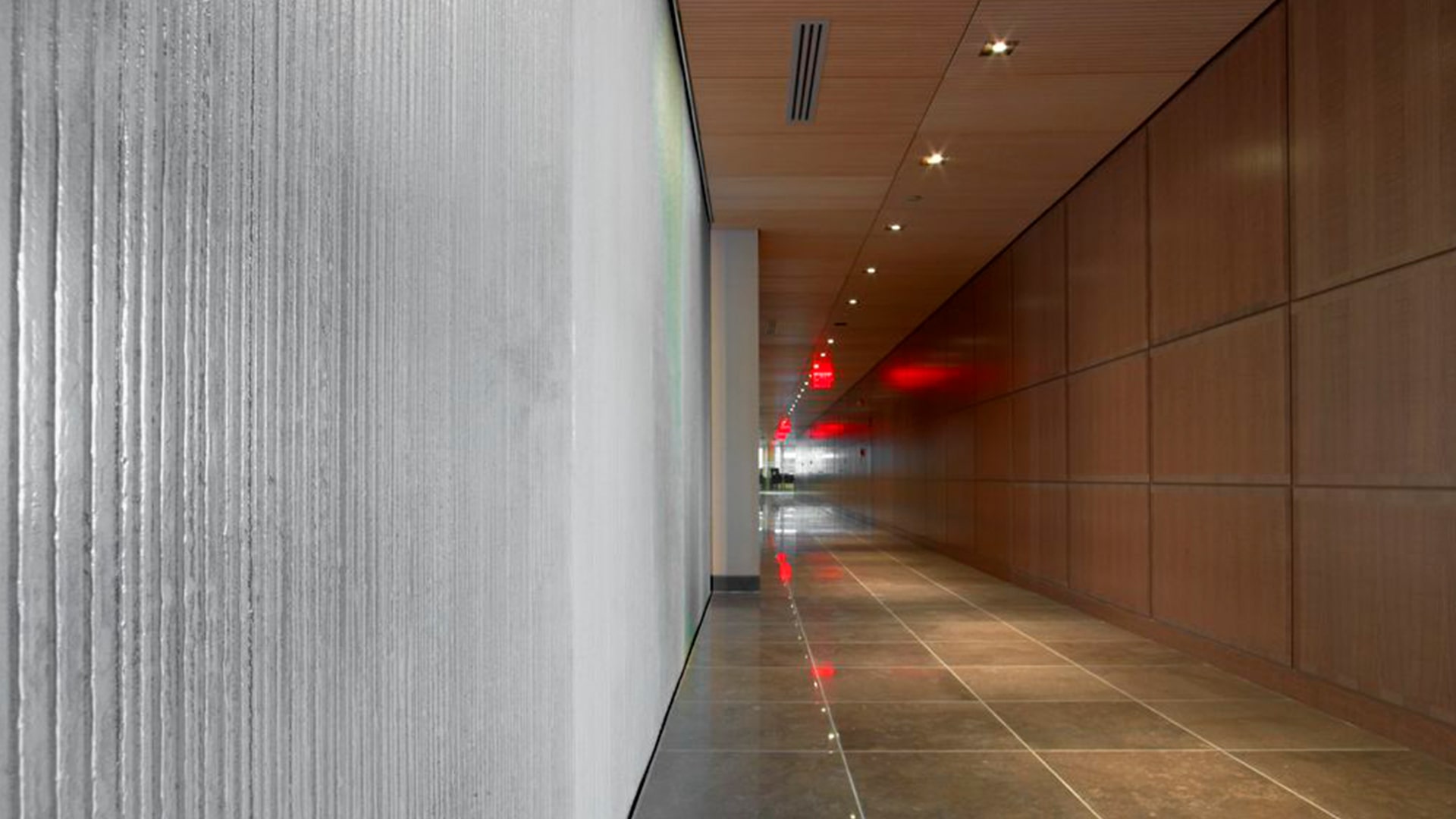
Fluted glass is flat glass carrying a repeating pattern of parallel grooves or ridges, produced by double rolling, by CNC engraving, or by kiln forming. The profile refracts transmitted light into vertical bands, which delivers graded privacy without sacrificing daylight, and the depth of that profile determines whether the panel behaves as a decorative surface or as an architectural element.
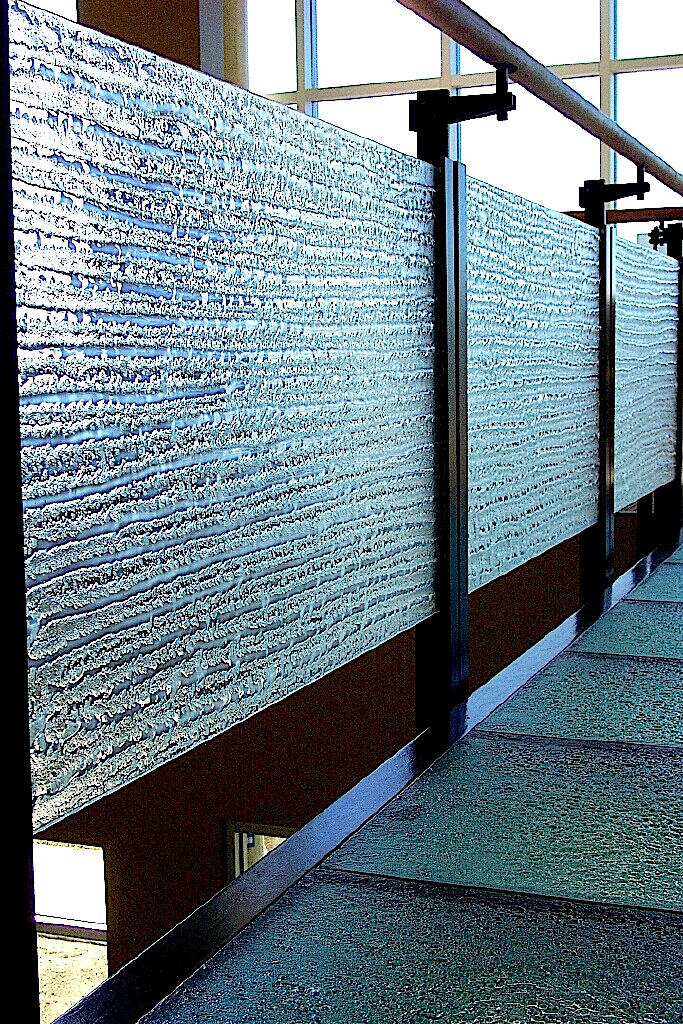
What is fluted glass?
Fluted glass is a patterned glass in which a linear profile is repeated across one face of the sheet, most often vertically. The market uses several names for the same family: reeded glass, ribbed glass, moru glass, linear pattern glass, and in heritage contexts figured rolled glass. Manufacturers rarely distinguish between them, and specifiers should assume the terms overlap until a profile drawing confirms otherwise.
Classical architecture does distinguish. Fluting describes concave channels cut into a column shaft or pilaster, separated by a sharp arris or a flat fillet, while reeding describes the inverse, a series of convex mouldings standing proud of the surface. Greek orders used concave flutes, with twenty grooves on a Doric shaft and twenty-four on Ionic, Corinthian and Composite columns. Egyptian architecture more often used the convex version. Applied to glass, the distinction still matters optically, because a convex rib and a concave channel bend light in opposite directions, but almost no supplier catalogue reflects it.
What defines the product in practice is not the name. It is three numbers: the pitch of the pattern, the depth of the relief, and the thickness of the substrate.
A pattern with a long industrial history
Patterned rolled glass is not a contemporary invention. James Hartley was granted a patent in 1838 for a rolled plate process in which molten glass was ladled onto a cast iron bed and pressed into a sheet with a heavy roller. By 1847 he had discovered that engraving the bed transferred a pattern to the glass, and his works were producing a ribbed obscured glass used to roof railway stations and greenhouses. Monkwearmouth station was among the first buildings glazed with it.
The method that still governs production today came later. Chance Brothers and Pilkington licensed Hartley's patent, and by 1890 Chance had patented a double rolling process in which the glass passed between two rollers, the upper one carrying the negative of the pattern. One face received the profile. The other was deliberately left flat so the sheet could be scored and cut. That asymmetry, decided in the nineteenth century, is the reason almost every fluted panel on the market today is textured on a single side.
Institutional collections still hold documented sample sets of these figured rolled patterns, which is how the original profiles remain traceable today. Ribbed and reeded panes then became ordinary equipment in Art Deco lobbies, corner storefronts and office doors, fell out of fashion for several decades, and returned as one of the defining material stories of the 2026 design cycle.
How fluted glass is manufactured
Three production routes exist, and they produce objects with very different structural and optical properties.
Double rolling. Glass is drawn at its softening point between patterned rollers that press the profile into the ribbon before it enters the annealing lehr. The route is fast, repeatable and inexpensive, and it is limited to whatever profiles the mill has already tooled. Standard narrow reeded stock carries a pattern width near 12 mm with a relief depth around 0.7 mm, and is supplied in nominal thicknesses from 3.5 mm to 12 mm.
CNC engraving. A flat annealed sheet is machined against a drawing, then the cut faces are polished back toward clarity. Pitch, depth and profile geometry become free variables, which allows deeper relief and non-standard rhythms. Cost rises with cutting time, and the polishing stage governs how transparent the finished grooves look.
Kiln fusing and thermoforming. Layers of float glass are stacked, fired until they bond into a single homogeneous plate, then reheated over a refractory mould so gravity draws the mass into relief. Annealing is matched to the maximum thickness so core and surface stresses equalise. This is the route described in detail in the kiln forming and thermoforming process used for architectural panels, and it produces linear relief measured in tens of millimetres rather than fractions of one.
At ThinkGlass, the linear textures are applied by hand without a repeating template, so no two panels in a run are mechanically identical. The LINEAR family covers three distinct rhythms, from a geometric line softened by organic variation to finer natural linework and a more agitated vertical movement. The first pairs naturally with brushed edges, the second with polished edges.
What the profile does to light
Each convex rib on the face of the sheet is, geometrically, a portion of a cylindrical lens. Light crossing it is refracted along one axis only. Objects behind the panel are not softened the way an acid etched surface softens them; they are cut into vertical bands and stretched laterally, which is why a hand pressed flat against reeded glass stays perfectly legible while a figure standing two metres back dissolves into colour.
That distance relationship is the single most useful property of the material, and it is routinely ignored during design. Obscuration is not a fixed characteristic of the sheet. It is a function of the separation between the glass and whatever sits behind it. Bottles 40 mm behind a cabinet door remain identifiable. The same door in front of a walk-in pantry conceals everything in it.
Pitch controls the scale of the effect. A 12 mm reed produces broad, calm bands. A 5 mm reed produces a finer optic that reads almost like corduroy across a room. Depth controls its strength: shallow rolled relief scatters gently, while deep relief bends light hard enough to throw visible caustics onto adjacent surfaces when a source rakes across the face at a low angle.
Orientation is the cheapest decision on the list and one of the most consequential. Vertical flutes extend a room upward and align with door stiles, mullions and cabinet rails. Horizontal flutes do the opposite and can flatten a low ceiling badly.
Two things the profile does not do deserve stating plainly. It does not improve acoustic separation, which comes from mass, from interlayers and from perimeter sealing rather than from surface geometry. It does not change solar or thermal performance either, since the relief redirects light without altering how much energy crosses the assembly. Specifying texture and expecting quiet is a recurring disappointment on office fit-outs.
Architectural applications of fluted glass
Thin fluted panels. Rolled and engraved stock in the 4 mm to 10 mm range covers most of the current market: cabinet and joinery inserts, interior doors and sidelights, shower screens, office partitions, reception screens and retail display fronts. In these positions the glass is an infill. Structural performance comes from the surrounding frame or hardware, and the specification questions are about safety glazing, edgework and how the flutes align with adjacent joinery.
Medium thickness fluted elements. Above roughly 19 mm the panel starts to read as a solid rather than a sheet. Bar fronts, reception counters, hostess stands, vanity fronts, shelving and backlit feature panels sit in this range. Edge presence becomes part of the design, and the relief reads in section as well as in elevation. Backlighting or edge lighting emphasises the internal geometry, which is why LED integration is so often specified with linear textures.
Extra thick fluted and kiln cast panels. Above roughly 35 mm the material behaves differently again. Kiln cast slabs carrying deep linear relief are used for lobby murals, donor monuments, storefront features and full height feature walls, where mass, not framing, provides stiffness. ThinkGlass produces fused pieces in nominal thicknesses of 35 mm, 48 mm, 72 mm and 88 mm, and up to 12 inches for exceptional work, in Crystal, Aqua and Bronze bodies. For a sense of what that mass means structurally, a fused tread 1.5 inches thick and 36 inches wide can carry up to 1,800 pounds while meeting Quebec building code requirements.
Built examples make the difference legible. A textured storefront produced for a luxury beauty retreat in Shanghai uses relief as the entire identity of the facade, and a glacial mural installed at Calgary Airport carries linear texture across a span no rolled sheet could reach. Work of this type is documented in the gallery of glass panels and walls and within the wider portfolio of architectural glass applications.
Safety, heat treatment and code compliance
The regulatory line is sharper than most design conversations acknowledge. Once a panel forms a door, a storm or combination door, a bathtub enclosure or a shower enclosure, it falls within the scope of the United States federal safety standard for architectural glazing materials, in force since 1977, which covers laminated, tempered, wired, organic coated and annealed glass. ANSI Z97.1 governs impact performance for safety glazing in similar positions, and ASTM C1048 covers heat treated flat glass. A decorative sheet does not become compliant because it looks calm.
Heat treatment is where fluted glass becomes genuinely awkward. Tempering relies on uniform heating and uniform quenching, and a profiled face gives neither. Only some figured glasses can be toughened, and whether a given profile qualifies depends on the depth of the embossing. Single rolled figured glass, textured on one face only, can generally be laminated to produce a safety glass. Double rolled figured glass, embossed on both faces, cannot be made into a safety glass at all. That single sentence eliminates a number of profiles from regulated positions before any aesthetic discussion begins. The underlying behaviour of each family under load and after breakage is set out in the comparison of tempered, laminated and cast glass and how each one fails.
Laminated build-ups are the usual answer for doors and overhead positions: a reeded lite bonded to a flat lite, commonly supplied around 8.8 mm and 10.8 mm nominal, retains fragments and keeps the assembly in its frame after breakage. Thick kiln cast panels take the opposite approach. They are annealed rather than tempered, because complex geometry cools unevenly, and their safety case rests on thickness, support conditions and engineered fixings.
Detailing constraints that decide the outcome
Sheet format is the quiet constraint. Rolled stock arrives in fixed jumbo sizes, commonly 1830 by 2440 mm and 2134 by 3660 mm, with maximum runs around 2000 by 5300 mm. Anything taller than a standard jumbo introduces a horizontal joint, and a horizontal joint crossing a vertical flute is the detail that undoes an otherwise disciplined partition. Kiln cast work escapes that ceiling because the piece is built rather than cut from a ribbon.
Edgework is the second trap. A flat pane accepts a polished or mitred edge cleanly. A profiled pane presents a saw-toothed section at every cut, so either the finish follows the relief or the flutes have to stop short of the perimeter. Clamping hardware raises the same issue, since patch fittings, channels and spigots are designed against flat contact faces.
Alignment is the third. Flutes read as a continuous rhythm only when adjacent panels are cut from the same pattern phase, which requires the fabricator to control where each cut falls relative to the profile. Left to chance, the joints between panels announce themselves.
Maintenance deserves honesty. Every groove increases surface area, and designers have started pushing back publicly on ridged surfaces for exactly that reason. Deeper relief collects more dust and takes longer to clean. My recommendation is to treat that as a specification input rather than a footnote: shallow relief in circulation spaces and food preparation zones, deeper relief where the surface is admired more often than it is wiped.
Summary table: fluted glass in architecture
Frequently asked questions about fluted glass
1. What is the difference between fluted, reeded and ribbed glass?
In the glass trade, almost nothing. The three terms, along with moru and linear pattern glass, are used interchangeably for sheets carrying a repeating linear profile. Classical architecture is stricter: fluting describes concave channels separated by an arris or a fillet, and reeding describes convex ridges standing proud of the surface. Since a concave channel and a convex rib refract light in opposite directions, the practical approach is to ignore the vocabulary and ask the supplier for a profile drawing showing pitch, depth and section geometry before committing.
2. How is fluted glass manufactured?
Volume stock is double rolled. The glass ribbon passes between two rollers at its softening point, the upper roller carrying the negative of the pattern, with the lower face deliberately left flat so the sheet can be scored and cut. That method has been standard since Chance Brothers patented it in 1890. The second route is CNC engraving, in which grooves are machined into an annealed sheet against a drawing and then polished; pitch and depth become fully custom, and the price reflects the cutting time. The third route is kiln forming, where stacked layers of float glass are fused into a single plate and thermoformed over a mould to produce relief measured in tens of millimetres.
3. Does fluted glass actually provide privacy?
It provides graded privacy that depends entirely on distance. Because each rib behaves as a cylindrical lens, an object touching the glass remains readable while the same object two metres back is smeared into vertical bands of colour. In practical terms, a fluted cabinet door conceals very little of what sits immediately behind it, whereas a fluted partition across a room reads as effectively opaque. Deeper relief and finer pitch both increase obscuration. For positions where content must be genuinely hidden at close range, an acid etched or laminated obscuring layer should be combined with the profile.
4. Can fluted glass be tempered or laminated?
Sometimes tempered, usually laminated. Toughening depends on uniform heating and quenching, and a profiled face compromises both, so only certain figured glasses can be tempered and eligibility depends on the depth of the embossing. Single rolled figured glass, textured on one face, can generally be laminated into a safety glass, commonly as a reeded lite bonded to a flat lite in nominal thicknesses around 8.8 mm and 10.8 mm. Double rolled figured glass, embossed on both faces, cannot be made into a safety glass. Thick kiln cast panels follow a different logic entirely: they are annealed, and their safety case rests on thickness, support conditions and engineered fixings rather than on heat treatment.
5. Is fluted glass permitted in doors and shower enclosures?
Only if the assembly meets safety glazing requirements for those positions. Doors, storm and combination doors, bathtub enclosures and shower enclosures fall within the scope of the United States federal safety standard for architectural glazing materials, which has applied since 1977, with ANSI Z97.1 governing impact classification. A decorative reeded sheet is not compliant by default. The compliant options are a temperable profile that has been toughened and certified, or a laminated build-up incorporating the reeded lite. Confirm the position before selecting the pattern, because eligibility narrows the catalogue considerably.
6. Does fluted glass improve acoustic or thermal performance?
No. Surface relief redirects light without adding mass, so a 6 mm fluted pane and a 6 mm flat pane behave essentially the same way against noise and against solar gain. Acoustic separation comes from mass, from laminated interlayers and from how the perimeter is sealed. Thermal and solar control come from coatings, tinted bodies and insulating glass build-ups. Where both texture and performance are required, the profile should be treated as one layer within an assembly that delivers the performance separately.
7. What thicknesses and panel sizes are available?
Rolled fluted stock is commonly supplied from 3.5 mm to 12 mm, engraved work from 4 mm to 19 mm, and kiln cast panels from 35 mm to 88 mm, with exceptional pieces reaching 12 inches. Standard jumbo sheets include 1830 by 2440 mm and 2134 by 3660 mm, with maximum production runs near 2000 by 5300 mm. Those formats set the real ceiling on panel height in rolled stock, and exceeding them means introducing a horizontal joint across the flutes. Kiln formed panels are built to the required dimension rather than cut from a ribbon, which removes that constraint for full height feature work.
8. Should the flutes run vertically or horizontally?
Vertical is the default for a reason. Vertical flutes emphasise ceiling height, align naturally with door stiles, mullions and cabinet rails, and match the visual logic of a fluted column. Horizontal flutes widen a space visually and can compress a low ceiling uncomfortably. Orientation also affects maintenance, since horizontal grooves collect dust and standing water more readily than vertical ones, which matters in bathrooms and food preparation areas.
9. How is fluted glass cleaned and maintained?
Glass itself is non-porous and chemically resistant, so cleaning is straightforward in principle. The complication is geometry: relief increases surface area, and grooves hold dust, residue and cleaning product more readily than a flat face. A soft brush or microfibre worked along the direction of the flutes, rather than across them, removes residue without leaving lint in the channels. Deep relief in high traffic or high humidity locations should be specified with the cleaning cycle in mind rather than as an afterthought.
10. What is the difference between rolled fluted glass and kiln formed fluted panels?
Depth, mass and behaviour. Rolled fluted glass carries relief measured in fractions of a millimetre on a thin substrate and functions as an infill within a frame. Kiln formed panels fuse multiple layers into a homogeneous plate before the relief is introduced, producing linear texture measured in tens of millimetres on a slab thick enough to act structurally. The optical result differs as well: shallow rolled relief produces a graphic effect on the surface, while deep cast relief produces a spatial one that changes as the viewer moves and as light shifts through the day. The two are specified for different problems, and treating them as interchangeable is the most common error in fluted glass procurement.