

Why Fused (Cast) Glass Becomes the Structural Reference in Advanced Architectural Applications
In architectural engineering, glass is no longer specified as a neutral, interchangeable material. The choice between tempered, laminated, and cast (fused) glass has direct consequences on structural behavior, failure modes, long-term durability, and design freedom. While all three can satisfy safety glazing requirements, they respond very differently to loads, impacts, and real-world use.
This distinction becomes critical in projects where glass is no longer an infill, but a primary architectural or structural element: kitchen and bar surfaces, stair systems, walkable floors, architectural panels, and exterior installations. In these contexts, fused glass increasingly emerges not as a niche material, but as a structurally coherent solution where thickness, mass, and predictability matter more than nominal strength values.
This article examines the engineering differences that truly matter, grounded in manufacturing processes, mechanical behavior, and standards, with a deliberate focus on why fused glass behaves differently and why that difference becomes decisive in demanding architectural applications.
Manufacturing Processes and Why They Dictate Performance
Tempered Glass: Strength Through Residual Stress
Tempered glass begins as annealed float glass that is reheated to approximately 620 °C and then rapidly quenched with air. This process induces surface compression on the order of 10,000 to 20,000 psi, counterbalanced by tensile stress in the core. The result is a material that exhibits roughly four to five times the apparent strength of annealed glass in bending.
This strength, however, is conditional. Any edge damage or deep surface flaw releases the internal stress balance, causing instantaneous fragmentation into small granules. Tempered glass therefore prioritizes impact safety, not structural continuity. Once failure initiates, load-bearing capacity drops to zero.
Laminated Glass: Safety Through Composite Action
Laminated glass bonds two or more glass plies using polymer interlayers such as PVB or EVA, typically ranging from 0.38 mm to over 1.52 mm. Under load, the assembly behaves as a composite system where shear transfer through the interlayer increases effective stiffness and, critically, maintains integrity after fracture.
From an engineering perspective, laminated glass is less about ultimate strength and more about post-breakage performance. Even when cracked, the system continues to carry load and remain in place. This is why laminated glass is mandatory in overhead, walkable, and fall-risk applications.
However, laminated systems remain dependent on the mechanical behavior of multiple thin plies. Vibration, deflection, and long-term creep of interlayers can become limiting factors in heavily loaded or high-traffic architectural uses.
Cast (Fused) Glass: Structural Mass and Homogeneity
Cast glass, often referred to in architectural practice as fused glass, is produced by pouring molten glass into molds and annealing it slowly to relieve internal stresses. Unlike float-based products, fused glass forms as a thick, monolithic mass with uniform internal structure.
While its nominal flexural strength aligns with annealed glass rather than tempered glass, this comparison is misleading in architectural contexts. Fused glass excels not through peak rupture strength, but through predictable stress distribution, mass-driven stiffness, and vibration damping. Thickness in fused glass is not a compensatory measure; it is an intrinsic structural attribute.
These characteristics make fused glass particularly suited for applications where glass behaves as a solid architectural component rather than a thin membrane.
Strength, Failure Modes, and Structural Consequences
Tempered Glass: High Strength, Zero Redundancy
Tempered glass can reach rupture stresses exceeding 120 ksi, but its failure mode is absolute. Once fractured, it disintegrates completely. This behavior is acceptable for doors, partitions, and infill glazing, but fundamentally incompatible with applications that require residual load capacity.
Laminated Glass: Controlled Failure, Variable Stiffness
Laminated glass offers excellent safety performance by retaining fragments after breakage. Structurally, however, stiffness is a function of interlayer shear behavior, which varies with temperature, load duration, and frequency. In walkable or high-use environments, this variability can lead to perceptible deflection and vibration even when thickness meets code minimums.
Fused Glass: Predictable Cracking, Structural Continuity
Fused glass does not shatter. It cracks in a controlled, predictable manner, similar to thick masonry or stone. This behavior is particularly valuable in architectural elements where glass is expected to read as a solid material, such as thick countertops, stair treads, or large architectural panels.
In practice, fused glass prioritizes serviceability: limited deflection, low vibration, and long-term stability under repeated loading.
Where Engineering Differences Become Architectural Decisions
Horizontal Surfaces: Countertops, Bars, and Tables
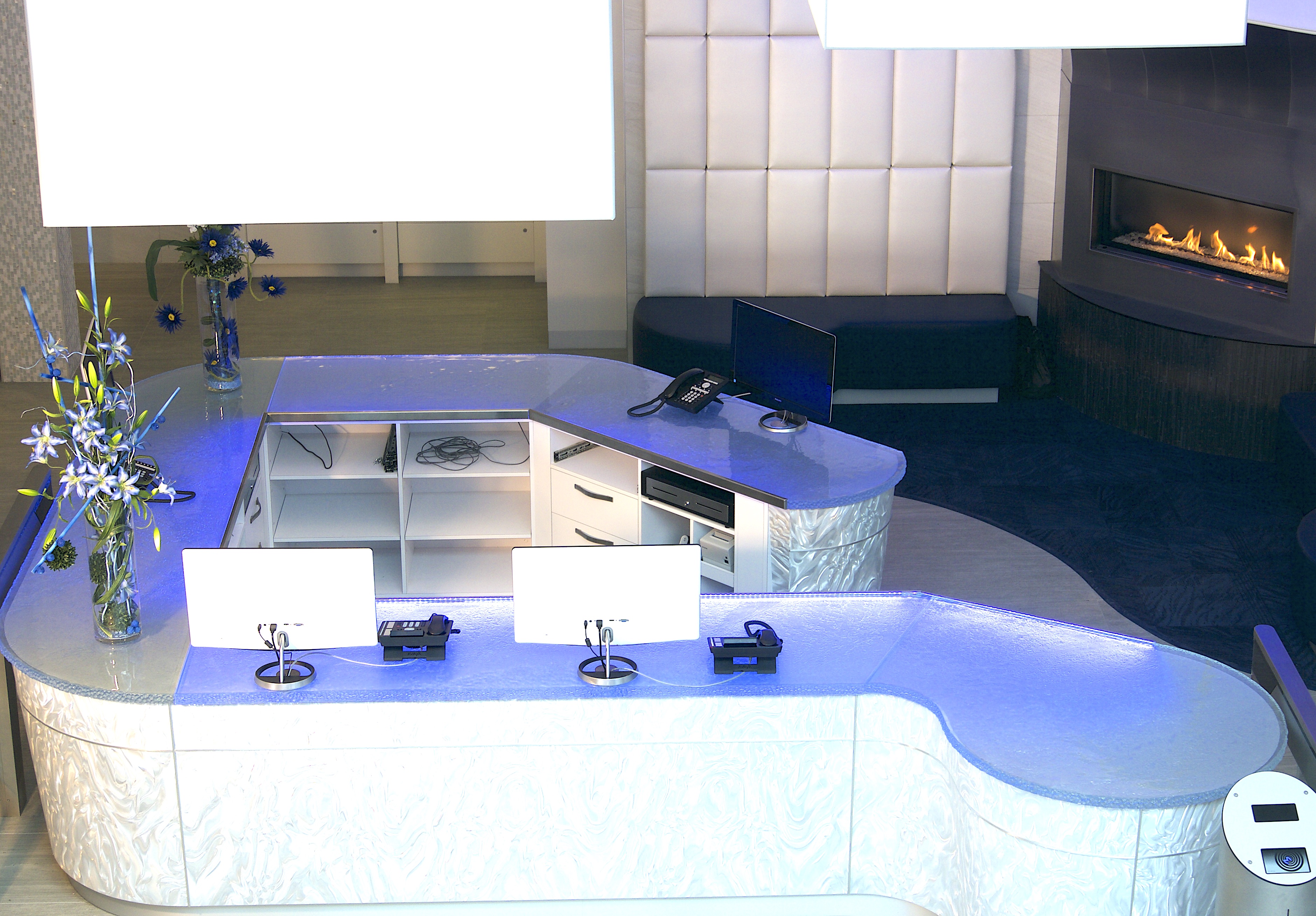
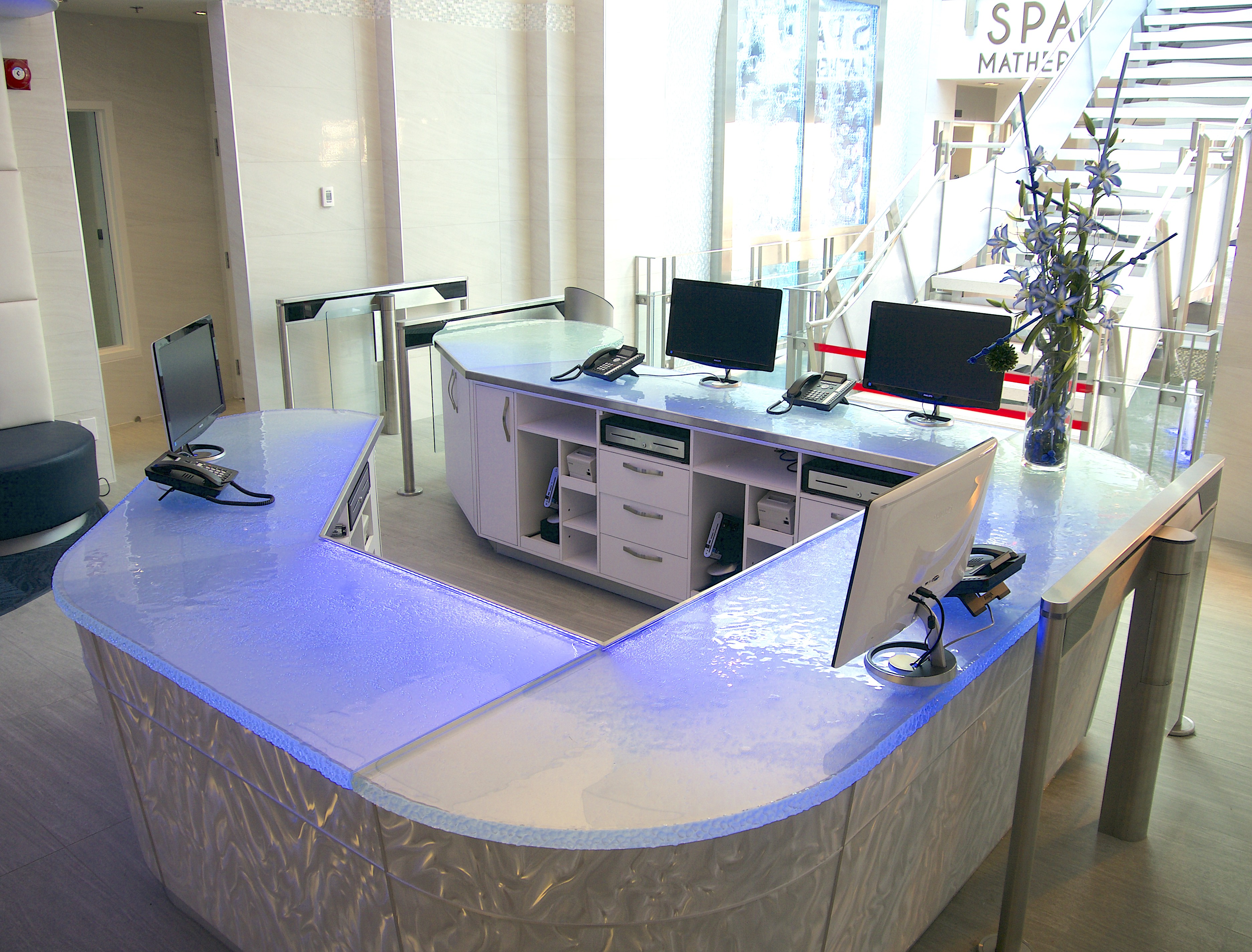
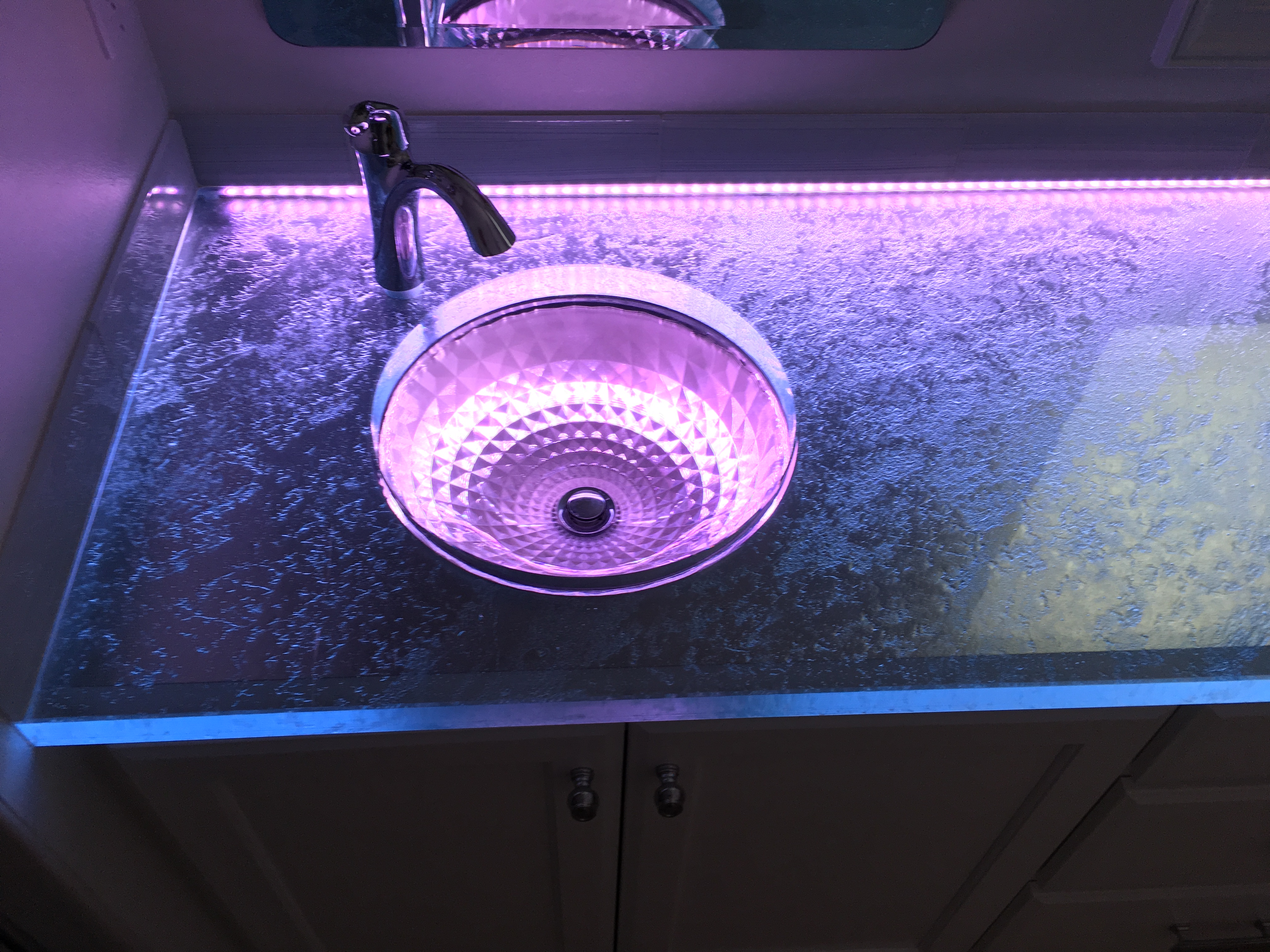
In applications like glass kitchen countertops and glass bar countertops, glass is subjected to concentrated loads, thermal cycling, and daily impacts. Tempered glass offers surface durability, laminated glass offers redundancy, but fused glass provides mass-driven stiffness that eliminates perceptible flex.
The thickness of fused glass in these contexts is not merely structural; it defines edge presence, visual depth, and tactile confidence.
Walkable Systems: Floors and Stairs
Walkable glass systems are governed as much by human perception as by strength. Even minimal deflection can feel unsafe. Fused glass used in structural glass floors benefits from its density and uniformity, which significantly reduce vibration.
The same logic applies to glass stair treads. Fused glass responds to dynamic foot traffic with a solid, damped behavior that thin laminated assemblies often struggle to achieve without excessive thickness or complex support.
Vertical and Exterior Architecture
In large-scale installations such as architectural glass panels and outdoor architectural glass applications, fused glass offers dimensional stability under wind load and thermal gradients. Its mass reduces sensitivity to temperature differentials and edge stress, supporting conservative, durable exterior design.
Engineering Comparison Table
In-Depth FAQs
From an engineering standpoint, what is the most important difference between tempered, laminated, and fused glass?
The key difference is not strength, but failure behavior and serviceability. Tempered glass is engineered to resist impact but fails instantaneously once its internal stress equilibrium is compromised. Laminated glass prioritizes post-breakage integrity by maintaining cohesion through an interlayer. Fused glass, by contrast, behaves as a massive, homogeneous material, distributing stress through thickness rather than relying on surface compression or polymer shear.
In architectural applications where glass is continuously loaded, walked on, or visually exposed, how a material behaves before failure is often more important than how strong it is at the moment of rupture. This is why fused glass is increasingly favored in structural uses such as glass stair treads and structural glass floors, where stiffness, damping, and predictability govern performance.
Why does tempered glass, despite its high strength, perform poorly in structural applications?
Tempered glass derives its strength from surface compression induced during quenching. While this allows it to resist high bending stress, it also makes the material extremely sensitive to edge damage and deep surface flaws. Once the compression layer is breached, the glass releases stored energy and disintegrates completely.
From a structural engineering perspective, this creates zero redundancy. There is no residual load capacity, no warning phase, and no controlled cracking. As a result, tempered glass is unsuitable for applications where continuity of load path is required, such as walkable surfaces, overhead glazing, or architectural elements expected to behave like solid materials.
Laminated glass is often required by code. Why is it still not always ideal for walkable or structural uses?
Laminated glass is essential for safety because it maintains integrity after fracture. However, its structural stiffness depends on interlayer shear behavior, which varies with temperature, load duration, and frequency. Under sustained or cyclic loading, the interlayer may behave viscoelastically, leading to increased deflection and vibration.
In walkable systems, this can result in glass that meets code requirements but still feels unstable underfoot. This limitation becomes apparent in floors and stairs, where user perception is critical. In contrast, fused glass assemblies rely on mass and thickness rather than interlayer stiffness, resulting in more stable, predictable behavior during everyday use.
How does fused glass fundamentally change the role of thickness?
In conventional glass systems, thickness is often increased to compensate for material variability or to reduce reliance on interlayer performance. In fused glass, thickness is intrinsic to structural behavior. The glass is formed as a monolithic mass with uniform internal structure, allowing stress to distribute evenly across the section.
This means thickness in fused glass directly translates into stiffness, vibration damping, and long-term durability. In applications such as glass kitchen countertops and glass bar countertops, this results in surfaces that feel solid, resist localized loading, and maintain dimensional stability over time.
Does fused glass still require lamination in structural or walkable applications?
In many cases, yes. Building codes often mandate lamination for redundancy, especially in overhead or fall-risk applications. However, fused glass fundamentally improves serviceability before fracture, meaning that lamination becomes a secondary safety layer rather than the primary contributor to stiffness.
In practical terms, this allows fused glass systems to achieve better performance with fewer compensatory layers, particularly in applications such as structural glass floors, where vibration and deflection control are critical.
Why is vibration control such a decisive factor in architectural glass?
Human sensitivity to vibration is extremely high, especially in transparent materials. Even minimal movement that is structurally acceptable can feel unsafe. This is why many glass floors and stairs fail not because of strength issues, but because occupants perceive instability.
Fused glass mitigates this problem through mass and density. Heavier, homogeneous panels dampen vibration naturally, reducing amplitude and frequency. This is a key reason fused glass performs so well in stairs and floors compared to thinner laminated assemblies relying on flexible interlayers.
How do support conditions affect the choice between laminated and fused glass?
Support conditions dictate stress distribution. Glass supported on four edges behaves very differently from glass supported on two edges or cantilevered. Frameless architectural designs, which minimize visible structure, reduce edge restraint and significantly increase bending stress.
In these cases, fused glass offers an advantage because thickness provides inherent stiffness without excessive reliance on framing or interlayers. This is particularly relevant in minimalist architectural systems such as architectural glass panels, where glass is intended to read as a primary structural surface.
Is fused glass suitable for exterior architectural applications?
Yes, particularly in applications exposed to thermal cycling and environmental stress. Fused glass exhibits stable behavior under temperature gradients due to its mass and annealed structure. This reduces sensitivity to thermal shock and edge stress.
As a result, fused glass is well suited for outdoor architectural glass applications, where long-term durability and dimensional stability are essential. Thickness in these contexts acts as both a structural and environmental buffer.
How do ASTM standards apply differently to tempered, laminated, and fused glass?
ASTM standards regulate performance outcomes, not aesthetic or manufacturing intent. Tempered glass typically falls under ASTM C1048, laminated glass under ASTM C1175, and cast or specialty glass under ASTM C1053 or related specifications.
What matters is that the final assembly meets load, deflection, and safety requirements. Fused glass systems are engineered to comply through thickness, support design, and-where required-lamination. The manufacturing process does not exempt a system from compliance, but it does influence how compliance is achieved.
Why is fused glass increasingly used where stone or concrete were once specified?
Because fused glass behaves like a solid architectural material while offering transparency, hygiene, and design flexibility. In applications where thickness is exposed-edges, stair treads, countertops-fused glass communicates mass, permanence, and precision.
Unlike thin glass sheets, fused glass does not read as fragile. It aligns architecturally with materials such as stone while offering advantages in light transmission and maintenance. This is why it is increasingly specified in high-end architectural projects where glass is expected to define space, not merely enclose it.
Who should ultimately decide which glass type is appropriate?
Final decisions must always involve a qualified structural or glazing engineer. Manufacturer guidance and architectural intent inform early design, but thickness, support conditions, and safety requirements must be validated through calculation and review.
Fused glass does not remove the need for engineering-it enhances the reliability of engineered solutions in applications where conventional glass systems reach their practical limits.

Engineering Reality Over Nominal Strength
Tempered, laminated, and fused glass are not interchangeable solutions. Each serves a distinct engineering purpose. Tempered glass prioritizes impact safety, laminated glass prioritizes post-breakage integrity, and fused glass prioritizes structural coherence and serviceability.
As architectural glass moves into roles traditionally held by stone, concrete, or steel, fused glass becomes less an alternative and more a reference. Its mass, predictability, and response to thickness make it uniquely suited for applications where glass is expected not just to enclose space, but to define structure itself.