

What is fused thermoformed glass?
Fused thermoformed glass is an architectural material produced by first kiln fusing multiple layers of flat glass into a single thicker sheet and then heat forming that sheet over or into a mold to introduce topography, curvature or deep texture. In the fusing stage, stacked glass layers are heated until they bond into a homogeneous mass. In the thermoforming stage, the fused plate is reheated to a softer state so that the mold, assisted by gravity create relief or shape. In architectural practice this family of products is often grouped under kiln formed, cast or slumped glass when used for panels, slabs and structural elements rather than small decorative objects. In buildings, fused thermoformed glass appears in thicknesses that range from near standard glazing to very thick slabs intended for heavily loaded applications.
How is fused thermoformed glass manufactured?
Production typically begins with float glass, clear, low iron or tinted, that is cut, cleaned and stacked in layers according to the desired final thickness and optical effect. The stack is placed on a refractory support inside a kiln and heated through controlled temperature ramps into the fusing range, where the individual layers soften and bond into a single piece. For many architectural applications, this fused plate is then cooled, inspected and, if required, refired over or into a forming mold. At thermoforming temperature, the viscosity is low enough for the glass to conform to the mold and capture textures, ribs or three-dimensional forms. In all cases, the piece is cooled according to an annealing schedule matched to its maximum thickness so that core and surface temperatures equalize and residual stress is minimized.
For thin architectural panels in locations that require glazing, fused thermoformed glass can in some cases be tempered, when the texture geometry and thickness allow, or laminated within a glazing build up so that the overall assembly complies with local glass standards. For heavy fused and kiln formed glass that is much thicker than standard architectural glazing, the glass is generally annealed only. In these cases, safety performance relies on thickness, support conditions and, when required, integration into engineered systems rather thanon tempering.
Advantages and reasons for use
Fused thermoformed glass offers a combination of mechanical robustness, durability and optical control that differs from flat monolithic glass. Fusing allows designers to build up substantial thickness from standard sheets, which increases stiffness and impact resistance and makes it possible to create solid feeling countertops, floors and stair elements. Thermoforming adds depth, texture and sculptural effects that can diffuse light, control glare and provide privacy while still transmitting daylight. The material is non porous and chemically resistant, so surfaces such as countertops, backsplashes and wall panels are compatible with intensive cleaning and hygiene requirements. Because each mold and firing cycle can be adjusted, fused thermoformed glass supports both one-of-a-kind installations and coordinated series of panels that repeat a texture or pattern across facades, partitions or stair assemblies.
Architectural applications of fused thermoformed glass
In architecture, fused thermoformed glass is used in both interior and exterior environments, where designers want to combine light transmission with pronounced relief, thickness or sculptural effects. Applications extend from thin interior panels and safety glazing infills to medium thickness surfaces such as tabletops and vanities, and to extra thick slabs for stair treads, bridges and walkable floors. The same kiln forming techniques are adapted to different thickness ranges and support conditions, which largely determine whether a piece functions as a decorative surface, a functional worktop or a structural glass element.
Thin fused thermoformed panels
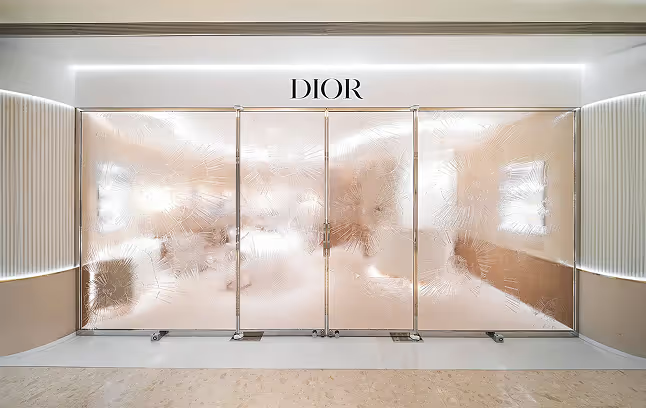
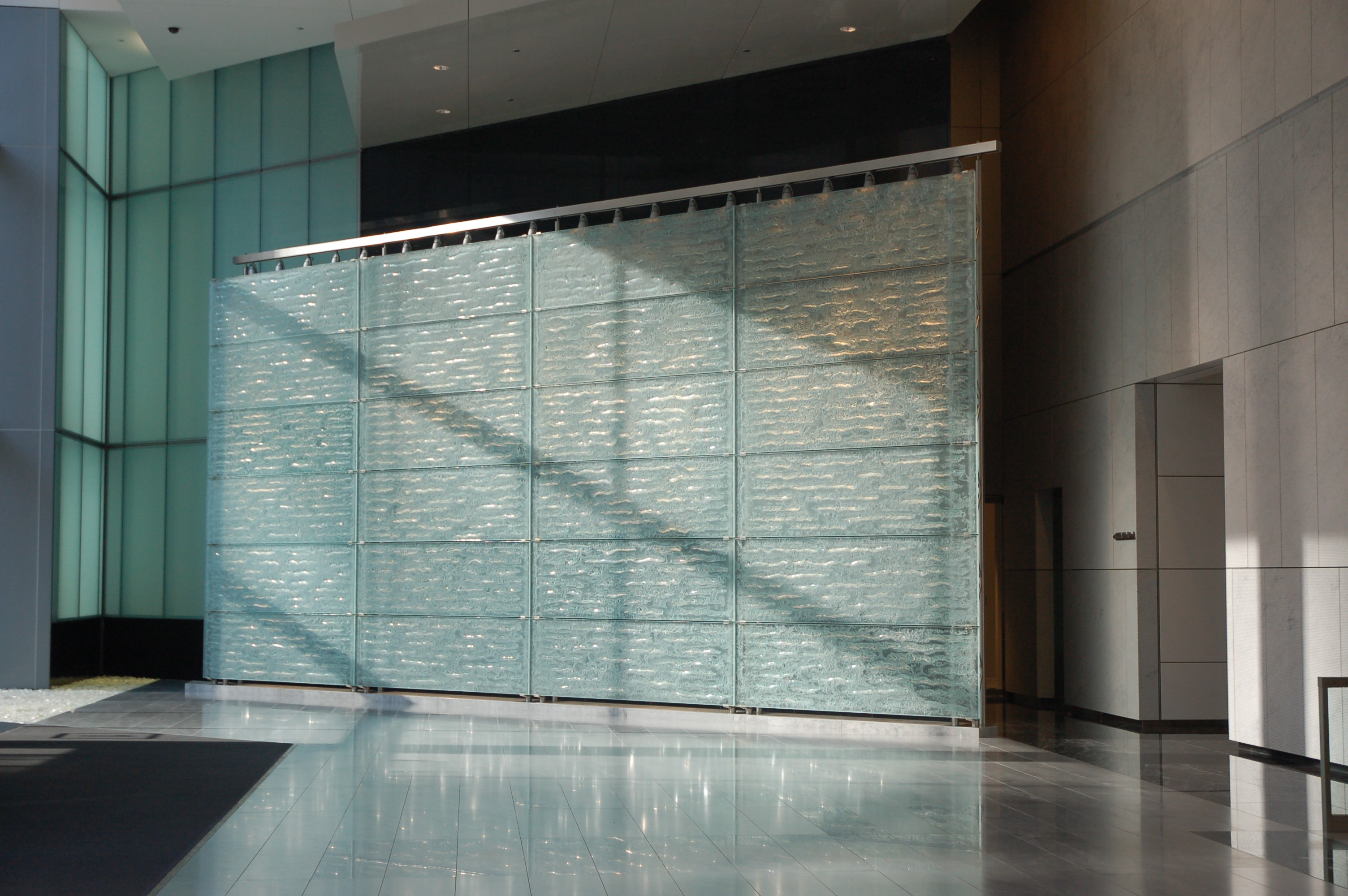
Thin fused thermoformed glass, typically comparable in thickness to standard architectural glass, is widely used as a decorative or privacy layer. Kiln formed textures and shallow relief patterns are applied to sheets, which can then be tempered or laminated and used as infill in railings, balustrades and pool fences, where translucency limits views while allowing light and sightlines to pass through. Similar panels appear in facades and storefronts, either as exterior spandrel or feature panels, or as interior layers behind primary weather resistive glazing, adding depth and pattern to otherwise flat curtain wall systems.
In residential or commercial interiors, fused thermoformed glass is also used for kitchen back splashes, wall cladding and shower or partition panels, to take advantage of its non-porous surface, ease of cleaning and ability to integrate color, graphics or relief patterns. Other thin panel applications include interior doors, canopies, skylight diffusers and decorative wall or ceiling panels, where kiln formed textures and bas relief patterns carry light and color across larger surfaces.
In addition to these uses, thin fused thermoformed panels are also specified for textured cabinet and drawer inserts, office or clinic privacy screens, elevator wall panels and branded signage. In such applications the glass is mainly used as alight modulating or backlit surface, while structural performances are provided by the surrounding framing or glazing system.
Medium thickness fused thermoformed elements
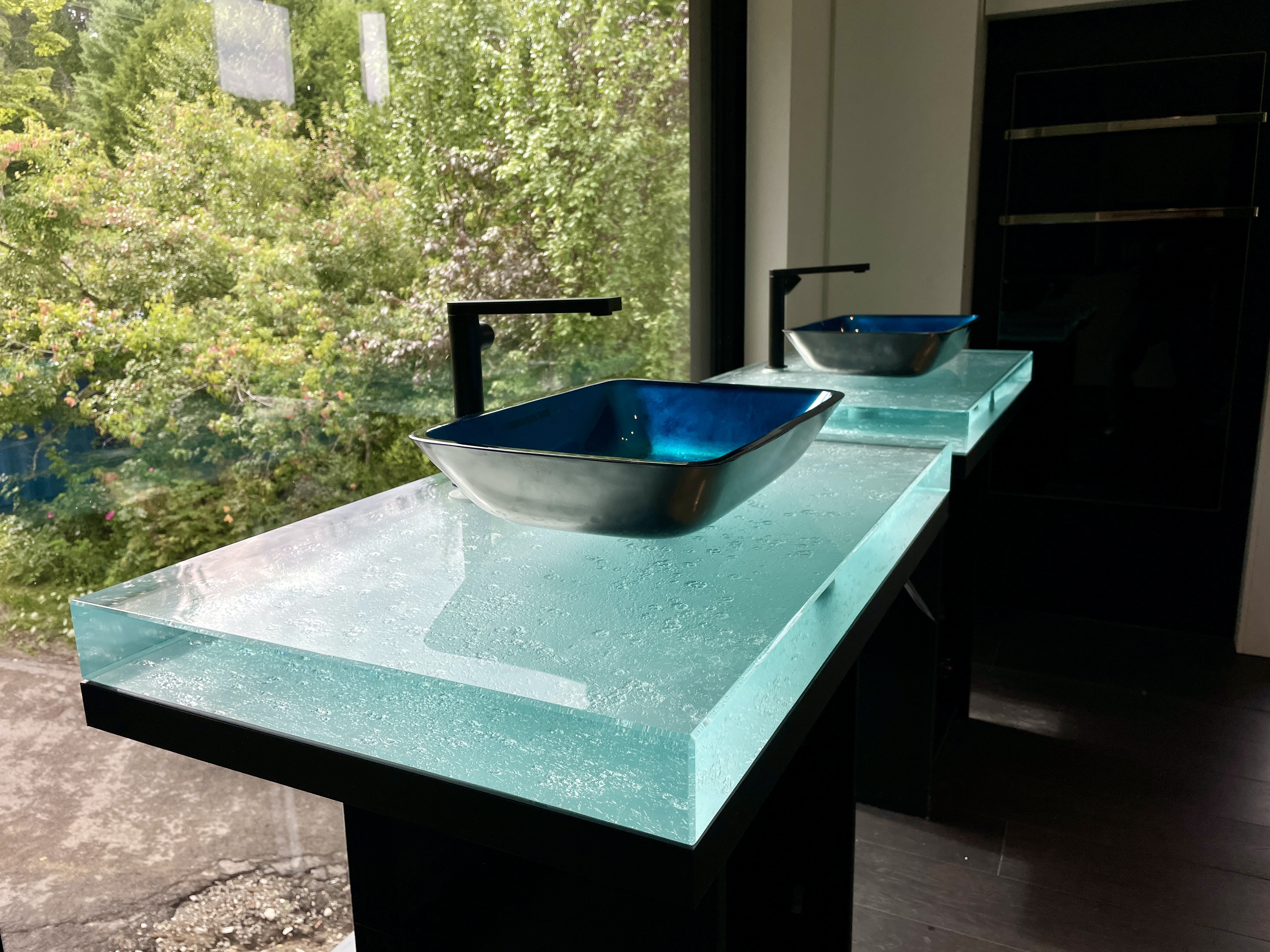
Medium thickness fused thermoformed glass is significantly thicker than standard glazing but does not reach the massive slab range. It is used where a sense of volume and edge presence is desired, while loads remain moderate. In kitchens, bathrooms, bars and hospitality interiors, fused glass countertops, bar tops, islands and vanity tops are designed in this thickness range to achieve a solid, stone like appearance with the additional benefits of light transmission and custom texturing. Conference tables, desks and reception counters made from layered and fused glass plates use visible edge layering and organic outer profiles as part of their aesthetic, while maintaining the flatness required for functional work surfaces.
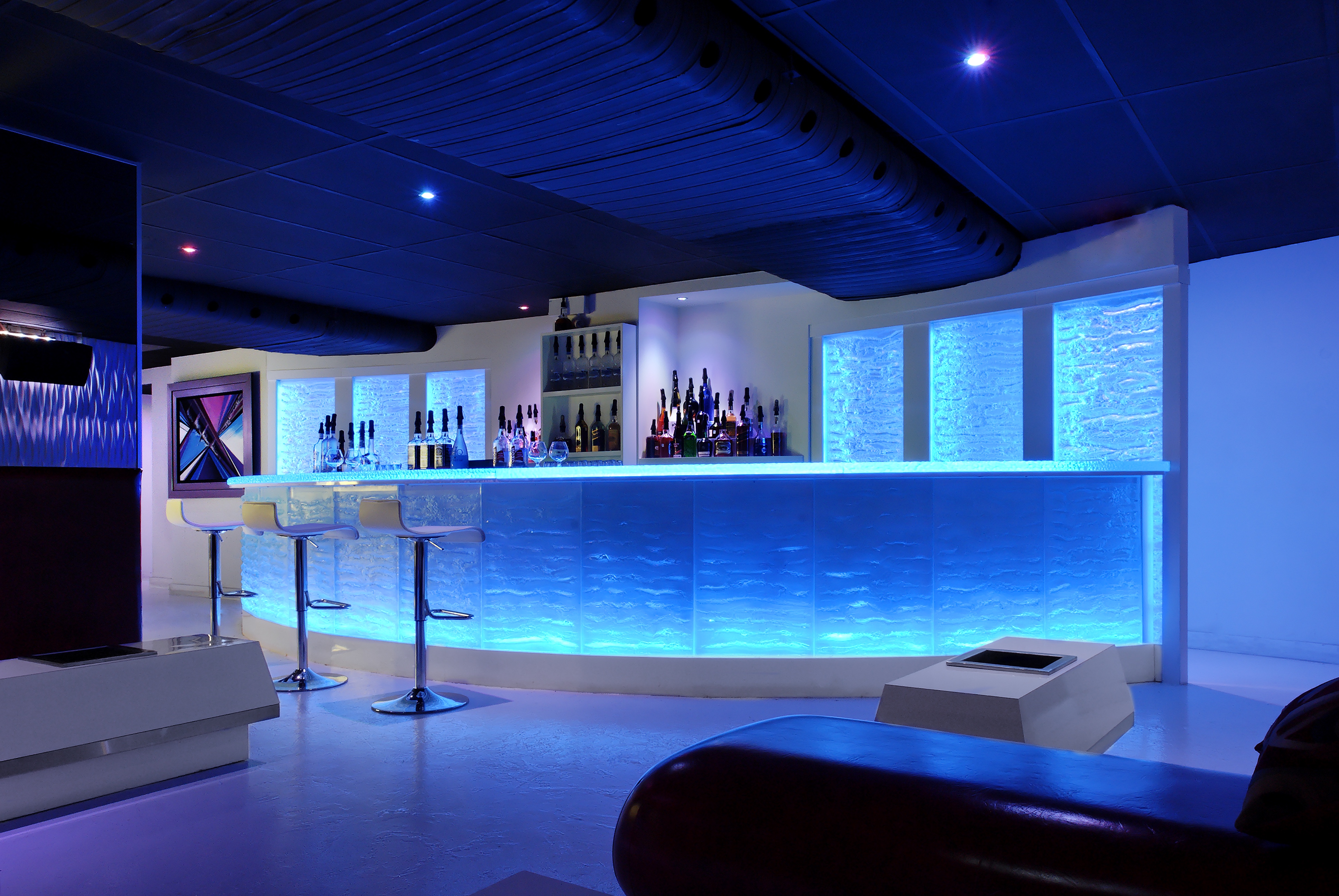
Medium thickness fused panels are also used for stair landings, railings, bar fronts, shelving and integrated lighting features, where the glass is backlit or edge lit to emphasize internal textures, natural entrapped bubbles and color gradients. Further applications include integrated glass sinks and basins, which can be formed to create three dimensional shapes. Other common options include fireplace mantels and surrounds, tub decks and shower thresholds, bench or window seat tops, retail display shelving and the faces of bars or hostess stands. In these cases, fused glass functions as a horizontal or vertical surface subject to moderate loads, supported by a substructure designed to carry the primary structural forces.
Extra thick fused thermoformed slabs
Extra thick fused thermoformed slabs are used for heavily loaded or walkable architectural elements. Manufacturers of fused and kiln cast glass floors and stair systems produce thick textured pieces that function as stair treads, landings, bridges and floor panels while transmitting light and, when required, incorporating slip-resistant surface treatments. In such applications, the glass is typically annealed and engineered as part of a structural system that can include metal stringers, frames or point-supported hardware.
Thick fused pieces are also used in custom railings and balustrades, either as monolithic sculpted panels or as deep textured infills, where their mass and stiffness can provide a robust alternative to multi ply laminated constructions, particularly in high end residential and hospitality projects. Beyond floors and stairs, extra thick fused thermoformed glass appears in architectural features such as cast glass trims, integrated art walls, bas relief facade panels and sculptural elements that contribute significantly to the visual identity of the space.
Beyond floors, stairs and railings, extra thick fused thermoformed glass can be used for cantilevered benches or seating surfaces, glass balusters and newel posts, vertical glass fins or ribs supporting adjacent glazing, or even landscape elements such as illuminated pavers, plinths or stepping stones. It is also employed in water features, for example as spillways, weirs or illuminated blocks, and in free-standing sculptural blocks or glass monoliths serving as spatial markers. These applications are typically engineered case by case so that glass dimensions, supports and fixings satisfy structural and safety requirements.
Summary Table - Fused Thermoformed Glass in Architecture
Frequently Asked Questions About Fused Thermoformed Glass in Architecture
1. Where did fused thermoformed glass come from in the past, and how did it change over time to be employed in architecture?
Fused glass processes have been used for more than 3,500 years, since ancient Egypt. Craftspeople around the Nile made early fused mosaics and inlays by fusing glass pieces together. The modern style came forth in the 1960s as part of the Studio Glass Movement. The 1962 Toledo Glass Workshop, which was organized by Harvey Littleton and taught fine arts students how to work with glass, helped start this movement. In the 1970s, businesses like Bullseye Glass (established in 1974) made sheet glass that could be fused together with matched coefficients of expansion (COE, usually 90 or 96). This made it possible to bond without cracking. By the 1980s, programmable kilns had made it possible to manage massive, repetitive elements in buildings, which changed the material from little ornamental pieces to architectural scales like panels and slabs.
2. How is fused thermoformed glass different from normal slumping glass?
Fused thermoformed glass typically combines fusing and forming in one extended kiln cycle, where several layers of glass (such as float glass sheets) are bonded into a thick, even plate while the softened mass sags over or into a mold to pick up texture or curvature. In some cases, the plate is first fused flat and then reheated for additional thermoforming. By contrast, simple slumping bends a single thin sheet over a mold without first building thickness, which limits the strength and stiffness of the piece. In architecture, the fusing step allows thicknesses on the order of 50 to 150 mm or more for load-bearing uses, whereas slumped glass is usually reserved for thinner, mostly decorative forms.
3. What materials and temperatures are utilized to make fused thermoformed glass?
The first step is to cut, clean, and stack compatible soda-lime glass (float: clear, low-iron or tinted / art: COE 90, 96 etc.) of the same composition. The stack is fired in a controlled way in the kiln: an initial ramp of about 200 to 400°F/hr (93 to 204°C/hr) up to roughly 1,000 to 1,250°F (538 to 677°C) with optional holds to equalize temperature, release stresses and help air escape; a faster heat to the full fuse range, typically 1,450 to 1,500°F (788 to 815°C), held long enough for the layers to bond into a single mass; an annealing hold around 900 to 1050°F (482 to 566°C) for 1 to 4 hours, depending on thickness and glass type, so stresses can equalize; and finally a slow cool at about 50 to 150°F/hr (28 to 83°C/hr) to room temperature. Materials include refractory moulds and kiln furniture made from high-temperature ceramics, castable refractories or fibre products, along with glass frits to adjust colour and texture. For architectural work, low-iron glass reduces greenish tint, and annealing schedules are tailored to slab thickness, with longer holds and slower cooling for pieces thicker than roughly 50 mm to avoid residual stress.
4. Is it possible to temper fused thermoformed glass?
Heating thin pieces (less than 19–25 mm with shallow textures) to about 1,148–1,256°F (620–680°C) and then quickly cooling them in a special oven will temper those pieces. However, medium and extra-thick pieces are not tempered because they cool unevenly in complicated shapes, which could cause them to break. Instead, they are annealed and depend on thickness, engineering supports (such as metal frames), and lamination to keep them safe. They follow standards like ASTM C1048 for heat-treated flat glass.
5. Is it safe to use fused thermoformed glass on stairs and floors that people can walk on?
Yes, when it is designed as a thick structural glass slab and supported correctly. For walkable applications, fused thermoformed glass is typically used in sections about 50 to 150 mm thick or more, fully annealed and textured with thermoforming or surface treated with etched or fritted patterns to improve slip resistance. These slabs are installed as part of engineered stair or floor systems with steel stringers, frames, or point-fixed hardware sized for the expected loads. Standard safety glazing requirements such as ANSI Z97.1 and CPSC 16 CFR 1201 generally apply to thinner guards and infill panels, while thick walkable slabs are mainly checked through structural engineering to carry the live loads specified by the building code, often around 100 psf or more, together with impact and concentrated loads.
6. Is it possible to use it outside or on façades?
Yes. Fused thermoformed glass can be used outdoors on façades or as exterior elements when it is detailed like other structural or decorative glass. Thick fused slabs are monolithic pieces of glass, so there is no polymer interlayer between sheets that can absorb moisture or delaminate; the glass itself is effectively waterproof. Their long-term performance depends mainly on support conditions, fixation details, allowance for thermal movement, and how perimeter joints are sealed and drained. When thinner fused panels are laminated for safety, their behaviour is similar to other laminated glass systems. The interlayer and edge seals must be protected from standing water, humidity, and UV. If water reaches the interlayer through poorly protected edges or failed seals, cloudiness or delamination can develop over time, which can reduce optical quality and, in some cases, affect residual safety performance. For this reason, exterior applications either use fused monolithic slabs in robust supports, or place thinner fused and thermoformed panels behind primary weather-resistant glazing so they remain dry while still providing depth, texture, and light control.
7. Is the surface as smooth as conventional glass?
In typical architectural fused thermoformed panels, one face is manufactured to be smooth and functionally flat, so objects such as plates or wine glasses sit without rocking and the surface appears almost mirror-like in normal viewing. The opposite face usually carries the molded relief, which can range from very light texture to deeper patterns, while remaining smooth to the touch. Slight, long-wavelength waviness can be present due to the forming process, but in properly designed panels this is generally low enough that it does not affect everyday use as a horizontal work surface or the overall visual impression of flatness.
8. How clean is it for kitchens and bathrooms?
Fused thermoformed glass is a non-porous, chemically resistant material, so liquids, dyes and residues stay on the surface rather than penetrating into the slab. The fire-polished surface is smooth and continuous, which limits places where dirt and microorganisms can lodge and makes it compatible with routine cleaning using most common household or commercial cleaners that are safe for glass. Unlike many natural stones, it does not require periodic sealing to maintain stain resistance, although joints, sealants and any support details remain the critical zones for hygiene and water management.
9. Is it possible to get fused thermoformed glass that is completely clear?
In practice, it is difficult to obtain fused thermoformed glass that matches the optical clarity of thin, flat float glass. The processes that build thickness and introduce relief tend to create gentle internal distortions, small bubbles, and refractive effects that make the material more translucent than perfectly transparent, especially in thicker sections. Using low-iron glass and shallow textures can produce slabs that look very clear in normal viewing, but when you look through the full thickness or across the textured face, there is usually some softening of the image rather than a completely undistorted, invisible view.