


Ask anyone why they hesitate to put glass on a staircase and you will hear the same two words: slippery and scratchable. It is the biggest objection in the category, the thing that makes homeowners pause and specifiers reach for a different material. It is also, with the right glass, exactly backwards. A properly made glass tread grips better wet than polished stone and shows wear less than the clear glass most people picture. The reason is not a coating that wears off or a lucky finish. It is a single design decision, made before the glass is ever poured, about which face of the material points up. Slip resistance is serious enough to carry its own published standards, the ANSI/NFSI B101 family maintained by the National Floor Safety Institute, and glass clears that bar comfortably when the surface is engineered for it rather than simply ordered off a sheet.
What follows are the three myths that keep glass off stairs and floors, what actually happens in service, and the one detail that explains all of it.

Myth 1: glass underfoot is slippery
The picture behind the fear is a sheet of smooth, clear glass, shiny and frictionless, the kind that turns into a skating rink the moment it gets wet. That picture is accurate. It is also the wrong material. It describes window glass, not the thick fused glass built for stairs and floors, which is designed to be the opposite of a smooth pane.
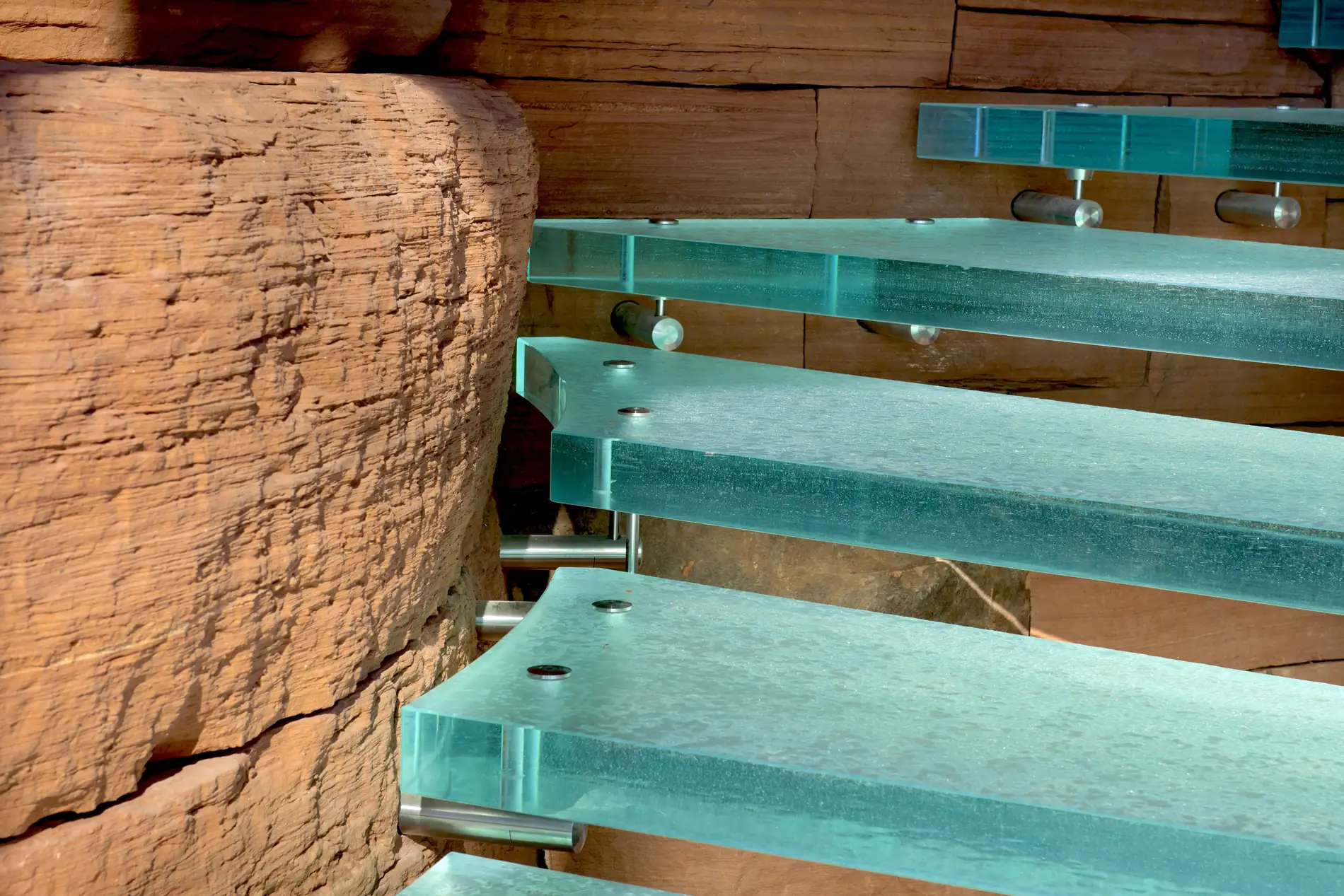
ThinkGlass treads are made with an organic texture, inspired by natural forms rather than stamped in a regular machine grid, and that texture is installed face-up, toward the foot. The difference is physical, not cosmetic. On a smooth surface a thin film of water sits between the sole and the glass and behaves like a lubricant. A varied micro-relief breaks that film into tiny discontinuous patches, so the foot keeps making real contact with high points of glass even when the surface is wet. It is the same principle that gives a hiking boot its lugs or a tire its tread, applied at a much finer scale. The payoff is genuine traction indoors and out, on interior steps and on exterior decks and poolside surrounds where wet conditions are the rule rather than the exception.
The texture does a second job at the same time, and it is one people underrate. It scatters light instead of bouncing it back in a single hard sheet, which softens glare and breaks the see-through effect. That matters for safety in a subtle way: a perfectly transparent tread gives the brain no visual cue that there is anything to stand on, so people tense up, grab the handrail, and shuffle. A textured glass stair tread reads as solid footing, so the body relaxes and moves naturally. On a floating or cantilevered staircase, where the treads seem to hover with nothing beneath them, that reassurance is the whole difference between a showpiece people admire from across the room and one they actually walk on. A relaxed, natural gait is, in itself, a safer one.
Myth 2: glass scratches at the first sign of grit
This one feels obvious and is just as wrong. The intuition comes, again, from smooth clear glass, where every scuff and swirl shows because there is nothing to hide it and the eye has a uniform mirror to compare against.
Turn the textured side up and the math changes. The raised high points of the relief are what meet every footstep, every grain of grit tracked in on a shoe, every pet claw. Glass is a genuinely hard material, harder at the surface than much of the natural stone people trust on stairs, so those high points take the contact without marking the way soft stone, sealed wood, or a polished clear surface would. And a textured surface is forgiving by nature. The faint marks that would scream across a mirror-smooth tread are simply lost in the visual noise of the texture; you would have to hunt for them, and you would not find much. Crucially, the surface does not wear smooth over time the way a finish or a coating does, because there is no coating to wear through. The texture is fused into the body of the glass, not applied on top of it. That is why ThinkGlass can say plainly that the texture will never wear out, and the surface physics behind the claim is the same one we unpack in our piece on why glass resists long-term wear.
Myth 3: it might survive a showroom, not real life
Texture science reads well on paper. The honest test is decades of real use, and that is where the case stops being theoretical. ThinkGlass treads carry real homes every day. The glass stair treads installed for the Krauter residence in Florida and the dramatic staircase at the Moongate Residence in Arizona are not laboratory pieces under glass; they are climbed, dragged across, and lived on, season after season.

The most extreme evidence is horizontal rather than vertical, and it is public. The glass floor tiles at the Bellagio Chocolate Shop have absorbed heavy, continuous foot traffic for more than twenty years, in a high-volume retail setting, without a single tile being replaced. Put the number in perspective. A floor in a casino shop sees more footsteps in a week than a private staircase sees in years. If the surface holds there, the worry about a home staircase scratching dull or wearing slick effectively disappears. Durability stops being a leap of faith and becomes a track record you can go and stand on.

The one detail that explains all three
Every answer above traces back to the same decision: the texture faces up. On stairs and floors that is deliberate, because the texture has two jobs to do exactly where the foot lands, gripping the surface and absorbing the wear. It is worth knowing that the same maker often does the opposite on a countertop, placing the texture underneath, because there the priority is a smooth, easy-to-wipe working surface and the visual interest can come from below. Same material, opposite orientation, each tuned to how the surface will be used. That is what anti-slip by design actually means: not a treatment added at the end, but a property built in from the orientation of the glass outward.
What slip-resistance testing measures
Because the claim is testable, it helps to know what the test looks at. Slip-resistance methods measure the coefficient of friction of a walking surface, wet and dry, and score it against a threshold. Texture-up fused glass performs because the measurement rewards precisely what the organic relief provides, grip that holds when water is present. ThinkGlass engineers each tread and floor around the project's safety and structural requirements and can support an engineer of record with documentation and available test data. A specifier is not asked to take the brand's word for it; the claim is something they can put in a submittal and stand behind.
Indoor, outdoor, and the wet edge cases
The places people most often rule glass out, the wet zones, are exactly where the texture earns its keep. Because the traction comes from a fused texture rather than a film or a sealant that degrades, the surfaces hold up on exterior steps, on decks, and on poolside surrounds when they are detailed for the conditions. The same logic runs straight across to horizontal surfaces, so a textured walkable glass floor feels reassuring underfoot instead of slick, and a full stair and floor program can run one consistent, safe surface from the bottom step to the top landing and out onto a glass deck beyond. Maintenance, the unspoken half of the slip question, is genuinely simple: a soft cloth or mop with ordinary glass or household cleaner, no sealing and no polishing routine, because the texture does not trap dirt and the surface is non-porous.
Comfort is part of safety
Slip and scratch numbers get the attention, but there is a quieter benefit that keeps people on a glass stair once it is installed: comfort. A textured tread is warmer and softer underfoot than people expect, and because the surface diffuses light rather than glaring, a staircase or floor of it feels calm rather than clinical. That comfort compounds over years of daily use. A surface you trust is one you stop thinking about, and the highest praise a staircase can earn is that the people who climb it every day forget it is made of glass at all. The same texture that grips the foot and shrugs off grit is the one that makes the surface pleasant to live with, which is why the design decision and the safety decision and the everyday-comfort decision all turn out to be the same decision.
The takeaway
The fear of slippery, scratch-prone glass is built on the wrong picture, a smooth windowpane standing in for a thick, textured, fused tread. Flip the picture and both classic objections turn into strengths. Texture-up glass grips when wet and hides wear, for decades, with no coating to fail and no finish to refresh. That is engineering, not luck, and it is why glass keeps appearing on the staircases and floors people once thought it could never serve. If safety underfoot is the reason glass has stayed off your project, it may be the very reason to look at it again, and the treads team can match a texture to your design and to the way the surface will really be used.