


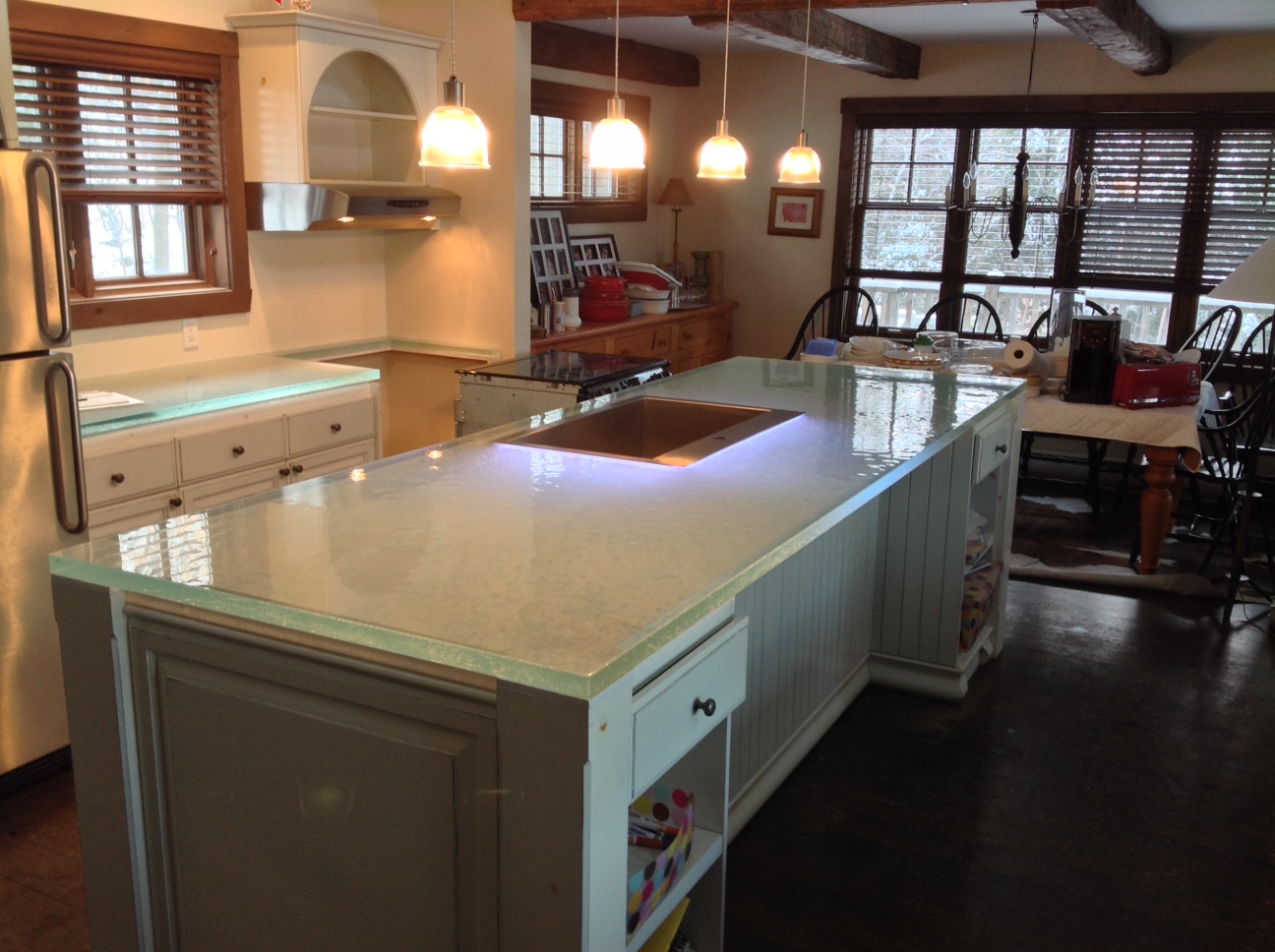
The question of scratching is the most common-and the most misunderstood-concern surrounding glass countertops. In architectural reality, glass is neither “scratch-proof” nor fragile in the way popular intuition suggests. Its long-term wear behavior is governed by surface physics, relative hardness, contact mechanics, and-critically-the type of glass and thickness strategy used.
Modern glass countertops are typically manufactured using tempered glass, fused (cast) glass, or fused-laminated assemblies. These materials operate around a Mohs hardness of 5.5–6, placing them on par with steel knives and below quartz or ceramic abrasives. This means scratching is physically possible, but its rate, visibility, and impact on longevity vary dramatically depending on how the glass is engineered and used.
This article explains why scratches form, how they accumulate over time, and why fused glass countertops exhibit fundamentally different wear behavior than thinner tempered alternatives-especially in high-use kitchens and bars.
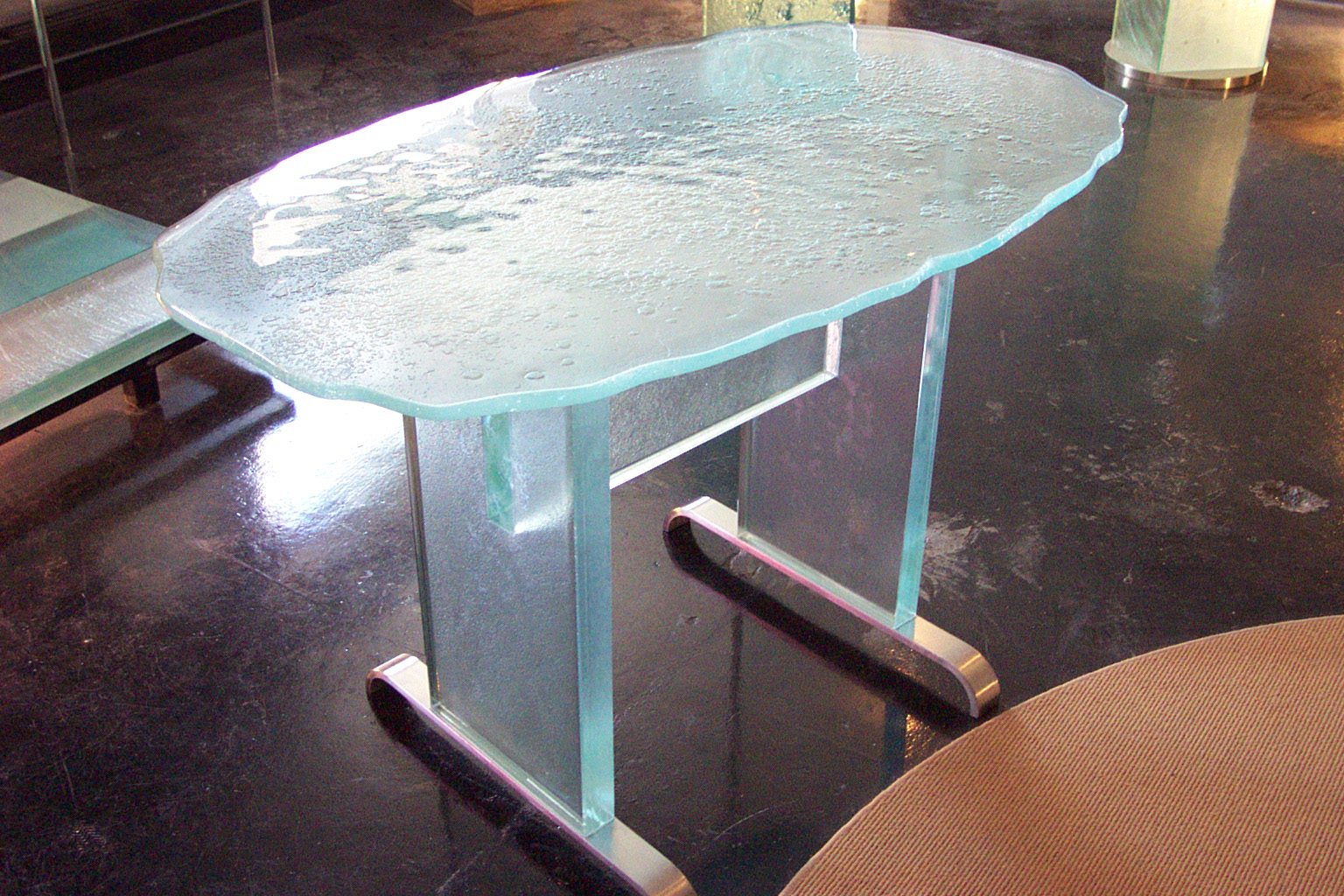
Understanding Scratch Physics on Glass Surfaces
Scratching is not a defect; it is a mechanical interaction. On glass, scratches form through micro-abrasion, a process where a harder asperity plows through a softer surface, displacing material rather than cutting it cleanly.
When a material with higher effective hardness-such as:
- quartz particles (Mohs ~7),
- ceramic grit (Mohs ~7),
- sand contamination on cookware bases,
is dragged across glass, it produces micro-grooves typically 1–10 microns deep. These grooves are not usually felt by touch but become visible under raking light due to changes in reflection.
Tempered glass resists the initiation of scratches better than annealed glass because of its surface compressive stress layer (≈10,000–20,000 psi). However, once a scratch penetrates that layer, the underlying silica network behaves like any other amorphous glass.
Fused glass behaves differently-not because it is “harder,” but because thickness, mass, and surface uniformity change how scratches accumulate and how visible they become over time.
Why Fused Glass Countertops Wear Differently Over Time
In applications such as glass kitchen countertops and glass bar countertops, the issue is not whether a scratch can occur, but whether daily use translates into visible degradation after years of service.
Fused glass countertops are cast as thick, monolithic slabs, often 30–50 mm or more. This mass has three decisive consequences:
- Scratch dispersion
Minor abrasions do not concentrate visually the way they do on thin sheets. Light scatter is absorbed by thickness and internal depth, making micro-scratches far less perceptible. - Surface stability under load
Thicker fused glass does not flex under localized pressure. Reduced flex means reduced abrasive engagement when objects are dragged across the surface. - Long-term polish retention
Because fused glass does not rely on thin surface treatments for stiffness, the surface finish remains stable even after years of micro-wear.
This is why, in real kitchens and hospitality environments, fused glass countertops tend to show patina rather than damage, even after a decade of daily use.
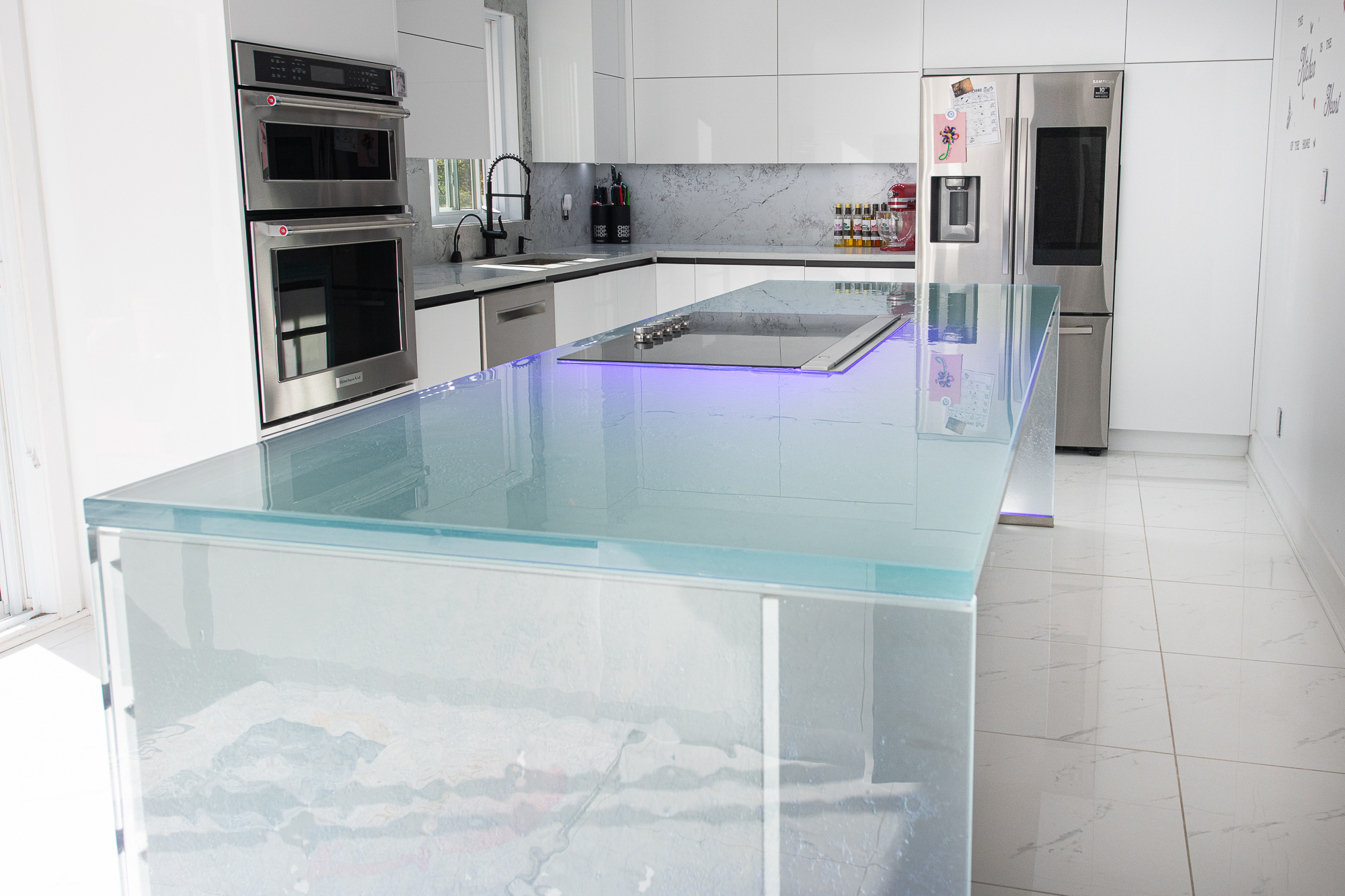
The Role of Surface Treatments and Coatings
Advanced surface treatments-such as hydrophobic or low-friction coatings-do not change the intrinsic hardness of glass, but they reduce friction and abrasive coupling.
By lowering the coefficient of friction, these coatings:
- reduce the energy transferred during contact,
- delay scratch initiation,
- and make existing micro-scratches less visible.
In controlled testing, coated glass surfaces retain over 90–95% optical clarity after five years of simulated heavy use, assuming normal maintenance. These coatings are not sacrificial finishes; they wear gradually and can typically be renewed after 7–10 years.
Importantly, coatings work best on dimensionally stable substrates-another area where fused glass outperforms thinner tempered systems.
Long-Term Wear: What Actually Happens Over 5, 10, 15 Years
Contrary to common assumptions, glass does not “etch” or chemically degrade under food acids. It is non-porous and chemically inert, unlike granite or marble, which develop pits and fissures over time.
Real-world wear on glass countertops typically follows this pattern:
- Years 1–3
No visible wear under normal use. Surface remains optically uniform. - Years 5–7
Fine swirl marks may appear under direct light if abrasive items are dragged regularly. These are cosmetic only. - 10+ years
On fused glass surfaces, wear manifests as a subtle softening of reflectivity rather than discrete scratches. Structural integrity and hygiene remain unchanged.
This behavior is one reason fused glass is increasingly specified not only in kitchens but also in architectural applications where longevity and surface stability matter more than initial hardness.
Durability Comparison Table: Glass Countertops in Real Use
How Use Habits Influence Scratch Visibility
Glass countertops are engineered surfaces, not cutting boards. The single most effective mitigation strategy is also the simplest: use cutting boards.
Normal habits dramatically extend surface aesthetics:
- Avoid dragging ceramic cookware.
- Rinse sand or grit from object bases.
- Use trivets for heavy impacts, not heat.
- Clean with microfiber rather than abrasives.
When these practices are followed, visible wear remains minimal even after long service life-especially on thick fused glass installations.
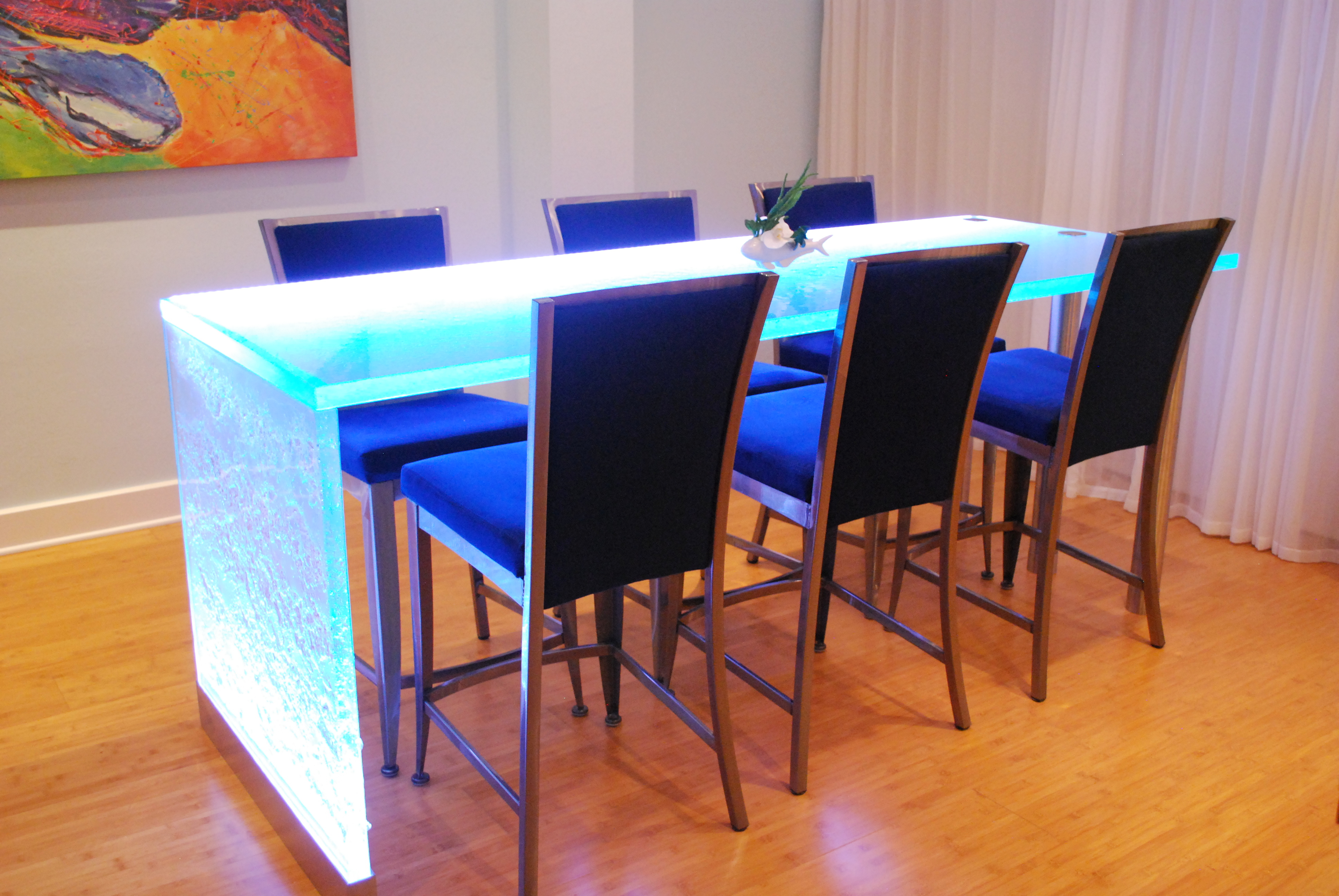
FAQs: Scratching, Wear, and Real-World Performance of Glass Countertops
Do glass countertops scratch in normal daily use, or only under misuse?
Glass countertops can scratch under normal use, but the key variable is frequency and severity of abrasive contact, not casual interaction. Scratches form when materials of equal or greater effective hardness-such as quartz particles, ceramic grit, or sand-are dragged across the surface repeatedly. Occasional contact with metal utensils rarely produces visible damage; long-term wear is instead driven by cumulative micro-abrasion.
In high-use environments such as glass kitchen countertops, visible wear typically appears only after years of repetitive abrasive motion, not from isolated events. When proper habits are followed, surface aesthetics remain stable for a decade or more.
Why do scratches on glass sometimes appear suddenly under certain lighting?
Scratches often exist long before they are noticed. They become visible when incident light aligns with the scratch geometry, creating specular reflection differences. This is why scratches may appear “overnight” when lighting conditions change, even though the surface degradation occurred gradually.
On thick fused glass surfaces, depth and internal light diffusion reduce this effect significantly, which is why scratches tend to read as soft patina rather than sharp visual defects.
Is Mohs hardness a reliable predictor of scratch resistance for countertops?
Mohs hardness is useful but incomplete. Scratching is governed by relative hardness, contact pressure, surface roughness, and motion. A steel knife and glass may share similar Mohs values, but scratching depends on edge geometry, applied force, and whether abrasive particles are present.
This explains why glass countertops are rarely scratched by knives alone, yet can develop wear from ceramic plates or sand-contaminated cookware bases.
Why do fused glass countertops age better visually than thinner tempered glass?
Fused glass countertops are produced as thick, monolithic slabs, often exceeding 30–50 mm. This thickness fundamentally alters how scratches accumulate and how light interacts with the surface.
Instead of isolated, high-contrast marks, fused glass distributes micro-abrasion across a larger optical volume. Reduced flex under load further limits abrasive engagement. In practical terms, this means that even when micro-scratches exist, they remain visually diffuse rather than concentrated.
This behavior is particularly advantageous in glass bar countertops, where lighting is directional and surface reflection is a dominant design element.
Do surface coatings actually prevent scratches or just hide them?
Surface coatings do not prevent scratches in an absolute sense. They function by reducing friction and surface energy, which lowers the probability of scratch initiation and reduces abrasive coupling.
Coatings delay wear and reduce visibility, but they do not change the underlying hardness of glass. Their effectiveness is maximized on dimensionally stable substrates, which is why they perform better on thick fused glass than on thinner glass sheets that flex under load.
How does repeated heat exposure affect scratch formation over time?
Heat itself does not cause scratches, but thermal cycling can influence surface behavior indirectly. Gradual exposure to temperatures up to 400 °F produces negligible micro-cracking in architectural glass. Rapid thermal shock, however, may increase surface stress concentrations, making subsequent abrasion more visible.
Fused glass countertops handle thermal cycling well due to their mass and annealed structure, which reduces internal stress gradients. This contributes to long-term polish retention.
Are scratches on glass countertops purely cosmetic, or do they weaken the surface?
Surface scratches on glass countertops are cosmetic only. They do not reduce load-bearing capacity, thermal resistance, or hygiene. Structural failure in glass is governed by edge damage, impact energy, and support conditions, not by superficial wear.
Unlike stone surfaces, scratches in glass do not propagate into fissures or create porous pathways for staining or bacterial retention.
How does glass compare to granite or quartz in long-term wear behavior?
Granite and quartz are harder materials, but they wear differently. Granite develops micro-fissures and chemical etching, which deepen over time and trap contaminants. Quartz surfaces rely on resin binders that can dull, discolor, or degrade under UV and heat.
Glass, by contrast, remains chemically inert and non-porous. Wear manifests as surface smoothing rather than structural degradation. This is why glass countertops maintain hygiene and visual clarity even after prolonged use.
Can scratches on glass countertops be repaired or reduced?
Yes. Fine scratches can often be reduced or visually eliminated through professional polishing or surface refinement. Because glass is homogeneous, there is no pattern loss or color mismatch during repair, unlike stone or engineered surfaces.
On fused glass countertops, repairs are typically localized and do not compromise overall surface integrity.
Why do cutting boards make such a large difference if glass is already hard?
Cutting boards eliminate sliding contact between hard edges and abrasive particles. Most scratching is caused not by the blade itself, but by grit trapped between the blade or object and the glass surface. Removing that interaction dramatically reduces wear rate.
In practice, consistent use of cutting boards is the single most effective strategy for preserving surface aesthetics over decades.
Do scratches affect hygiene or food safety?
No. Glass remains non-porous even when scratched. Micro-abrasions do not absorb liquids or harbor bacteria. This is a major advantage over stone surfaces, where scratches and pits can compromise hygiene without visible warning.
Is fused glass more appropriate for high-traffic or commercial environments?
Yes. In commercial kitchens, bars, and hospitality spaces, fused glass is often preferred because its thickness and mass mitigate both visual wear and vibration. The surface maintains its appearance longer under repetitive use, especially in environments with directional lighting and frequent contact.
This is one reason fused glass is increasingly specified not only for residential kitchens, but also for architectural applications where durability and long-term appearance are critical.
At what point does wear justify resurfacing or replacement?
In most cases, never. Wear on glass countertops tends to plateau once an equilibrium patina forms. Unless severe impact damage occurs at edges, glass countertops typically outlast cabinetry and surrounding finishes without requiring replacement.
Conclusion: Scratching Is a Physics Question, Not a Material Flaw
Glass countertops can scratch-because all materials do under sufficient abrasion. The relevant question is how those scratches form, how visible they become, and whether they affect long-term performance.
In this context, fused glass distinguishes itself. By leveraging thickness, mass, and surface stability, it transforms scratching from a visible defect into a controlled, cosmetic phenomenon that does not compromise durability, hygiene, or structural integrity.
For architects, designers, and homeowners evaluating long-term value rather than short-term fear, the data is clear: glass countertops do not fail by scratching-they age by patina, and fused glass does so with exceptional consistency.