


Walk into a basement media lounge, an interior boardroom with no exterior wall, or a hotel corridor buried in the core of the building, and your body registers the problem before your eyes do. There is a flatness to a windowless room, a sense that the air itself has stopped moving. The International WELL Building Institute, which writes one of the most widely used health-focused building standards, has linked daylight and outward views to performance gains in the range of 6 to 12 percent for the people who work in those spaces, and windowless environments to poorer sleep and lower mood. Making a windowless room feel brighter, larger and genuinely luxurious is not about fighting that reality with more ceiling pot lights. It is about giving the eye something to travel toward, and giving light something beautiful to live inside.
I have watched designers try to brute-force the problem with lumens alone, flooding a room until it feels like a dentist's office at noon. It never reads as luxury. The rooms that work borrow the behavior of daylight rather than its raw quantity, and glass turns out to be the material that does this best.
Start by diagnosing what the room is actually missing
A windowless room is short three things at once, and most renovations only address one of them. The first is luminance variation, the gentle gradient from bright to dim that a window creates across a wall. The second is depth, the layered sense of distance that your eye reads as spaciousness. The third is a focal point, somewhere for attention to rest. Flat downlighting gives you brightness but erases variation, depth and focus in a single stroke. That is why a heavily lit windowless room can still feel claustrophobic.
Before choosing finishes, it helps to name which of the three deficits bothers you most. A home theatre may want depth and a focal glow without raising overall brightness. A reception area wants all three. Once you know the target, the material choices almost make themselves.
The reflex to avoid: mirror everything
The instinct in a tight, dark room is to line it with mirror. Mirror does enlarge a space, but it also doubles the clutter, bounces glare straight back at eye level, and reads as a 1980s gym when overused. A sheet of mirror reflects the problem. Textured and backlit glass, by contrast, diffuses and softens, so it adds the sense of a luminous surface without copying everything in front of it. That difference, reflection versus diffusion, is the whole game in a windowless room.
Use a luminous surface as a substitute sun
The single most effective move in a room with no windows is to build one source of large, soft, glareless light into a vertical surface. Not a fixture you look at, but a plane that glows. A thick slab of textured glass, lit from behind or from a concealed edge, behaves remarkably like a frosted window on an overcast day. The texture scatters the light so you never see a hot spot or a bulb, only an even wash that falls across the room the way daylight falls through a sheer curtain.
ThinkGlass built exactly this effect into the glass feature wall for Building One South Dearborn, a tall backlit glass surface lit so that the texture and movement in the glass become the light source itself. In a windowless setting, a piece like that does double duty. It is the art you look at and the window you do not have. Because fused glass can be cast several centimeters thick with real depth and internal texture, the glow has dimension to it, which a flat printed lightbox panel never achieves. If you are weighing options for the wall itself, this is where the range of custom backlit glass panels and walls earns its place, because the panel is engineered as both structure and luminaire.
Borrow daylight's color behavior, not just its brightness
Real daylight shifts through the day, cool and bright at midday, warm and low in the evening. A windowless room feels artificial partly because its light never changes. One of the more convincing luxury upgrades is tunable LED behind or around the glass, set to drift from a cooler white in the morning to a warmer tone at night. The glass diffuses it all into one soft field, and the room quietly tracks the time of day the way a room with windows would.
Here is a practical ranking of the levers, from the ones that change the feeling of the room most to the ones that help at the margins.
Make the room feel larger by giving light somewhere to travel
Perceived size is mostly about sightlines. A room feels bigger when the eye can read distance, and a dark, opaque wall at close range tells the eye the room stops here. Replacing that wall, or part of it, with a translucent glass partition lets light and shadow pass through, so the brain reads a second volume beyond the glass even when the actual footprint has not changed. This is why a textured glass divider between a windowless den and a brighter hallway can make the den feel like it doubled, while a solid wall in the same spot makes it feel like a box.

Thickness and texture do the heavy lifting
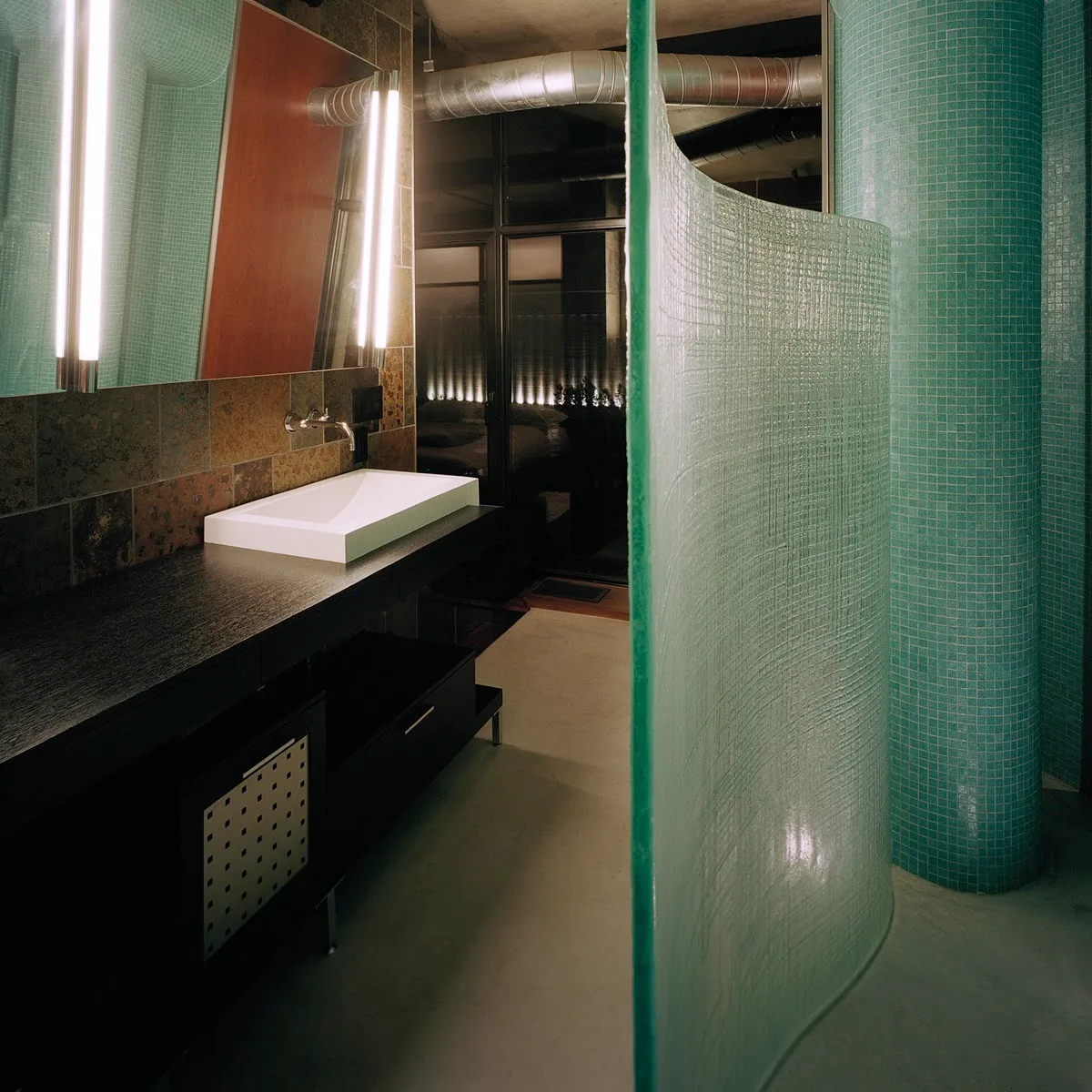
Not all glass reads as luxurious, and the difference is usually thickness. Thin, flat decorative glass looks like a shower screen. A thick fused slab with a sculpted surface catches light along its depth, throwing soft internal highlights that shift as you move past it. That movement is what the eye reads as richness. The same principle that governs a dense, hand-finished architectural glass feature in a lobby applies to a small windowless powder room: the more the surface does with light, the less the room misses a window.

Keep the hardware invisible
Luxury in a windowless room is quiet. The moment someone spots the LED strip, the magic drops. Concealed channels, frameless or minimal-frame mounting, and a diffuser that hides the individual diodes are what separate a convincing glowing wall from a lit sign. It is worth spending the detailing budget here rather than on a bigger light output.
A simple sequence that works
If you are planning the room from scratch, a reliable order of operations keeps the result coherent. Decide the single focal surface first, because everything else supports it. Choose the glass texture and thickness for that surface against a physical sample, under the actual LED you intend to use, since texture and light source behave as a pair. Set the surrounding finishes pale and low in sheen so they pass the glow along instead of absorbing it. Add perimeter and accent light last, at a lower level than the feature, so the feature always reads as the brightest, softest thing in the room. Resist the urge to add a second strong glowing element, because two suns cancel each other and the sense of a real light source collapses.
Done in that order, a basement, an interior office or a core corridor stops feeling like a space the building forgot and starts feeling like a room that was designed around one beautiful source of light. That is a more honest kind of luxury than a wall of mirror, and it lasts. For a feature wall that has to carry the whole room, a custom piece of architectural glass is usually where that budget does the most work.
Applying the idea to real rooms
The principle is steady, but the execution shifts with the room, because each windowless space fails in its own way. A few common cases show how the same toolkit gets tuned.
The basement lounge or home theatre
Basements carry a particular heaviness, low ceilings and no natural light at once. The mistake is to light them evenly and end up with a bright box that still feels underground. A better move is a single glowing glass feature on the main wall, kept warm and dimmable, with everything else dropped low. In a theatre you want the feature to fall to almost nothing during a film and rise to a soft glow between scenes, so the room has a resting state that feels intentional rather than simply dark. The glass does the heavy work of giving the eye one beautiful place to land.
The interior office or boardroom
A core office with no exterior wall is where the wellbeing research bites hardest, since people spend full days there. Here the goal is a steady, daylight-like field rather than drama. A large backlit glass partition between the room and a brighter corridor borrows light, adds depth, and softens the sense of enclosure, while tunable white behind it can track the day so the space does not feel frozen at noon from morning to night. The partition also buys a psychological win: the eye reads a world beyond the glass, and the room stops feeling sealed.
The powder room and small windowless bath
Small windowless rooms are the easiest to transform, because one surface fills the whole field of view. A backlit textured glass panel behind the vanity, or a glowing glass counter, turns the entire room into a jewel box. Because the space is tiny, the cost of a single luxurious glass surface is modest relative to its impact, which makes these rooms the best place to start if you want to see the effect before committing to a larger project.
Cost, longevity and why it holds its value
A glowing glass feature is not the cheapest way to light a room, and it would be dishonest to pretend otherwise. What it offers instead is permanence. A well-made fused glass panel does not yellow, fade or date the way a trend-driven fixture does, and the LED behind it is the only part likely to need attention over a long life. Spread across the years a feature like this stays in service, it often compares well with repainting, refixturing and redecorating a room that never quite solved its lack of light. The value is in solving the problem once, with a surface that reads as art rather than as a lighting fix.
Questions people ask about brightening a windowless room
Can backlit glass really replace the feeling of a window?
It does not replace a view, but it convincingly replaces the soft, glareless light a window provides on a cloudy day. A large textured glass surface lit from behind gives the eye an even, diffuse plane of light with no visible bulb, which is the quality most people actually miss in a windowless room, more than the view itself.
What is the biggest mistake in lighting a room with no windows?
Adding more ceiling downlights. They raise brightness but flatten the room, erasing the variation and depth that make a space feel open. A single large soft light source in a vertical surface does far more for the feeling of the room than a grid of recessed lights ever will.
Does a glass partition reduce privacy in a small space?
Not necessarily. Textured and sandblasted glass transmits light while blocking a clear view, so a partition can borrow brightness from the next room without opening a line of sight. You choose the texture and opacity to match the privacy you need, from barely frosted to almost solid.
Is colored glass too bold for a small windowless room?
Color can work beautifully when the glass is the only strong source of light, because the whole room takes on a gentle tint rather than fighting a competing window. The key is restraint in the surrounding palette. One luminous colored surface against calm neutral walls reads as intentional, not loud.
If the goal is a windowless room that feels like somewhere you would actually want to linger, the answer is almost never more light. It is better light, held inside a surface worth looking at.