

The kitchen island has become the focal point of the modern North American kitchen. No longer just an extra surface for food preparation, today’s island combines form and function: it is a workstation, a gathering space, a design statement, and sometimes even a dining area. As open-plan layouts and multifunctional kitchens continue to dominate residential design, the choice of island materials has gained importance.
Among granite, quartz, wood, and stainless steel, glass kitchen islands have emerged as one of the most innovative and luxurious options. Their ability to combine light, transparency, hygiene, and durability makes them a material of choice for both residential homeowners and design professionals in 2025. This guide explores everything you need to know: why glass is ideal, the different types of glass available, durability and safety standards, design inspirations, maintenance requirements, and North American market trends.
Why Choose a Glass Kitchen Island?
The appeal of glass as a kitchen island surface goes far beyond its glossy look. It delivers a unique set of functional and aesthetic benefits that position it apart from traditional countertop materials.
Timeless beauty and more light
Glass reflects and lets light through, making kitchens brighter right away and giving them a sense of space. For kitchens in cities that are small, glass helps bring in as much natural light as possible. In bigger suburban or luxury settings, thick glass slabs or LED-lit textures make the island look like a work of art.
Adaptability and Customization
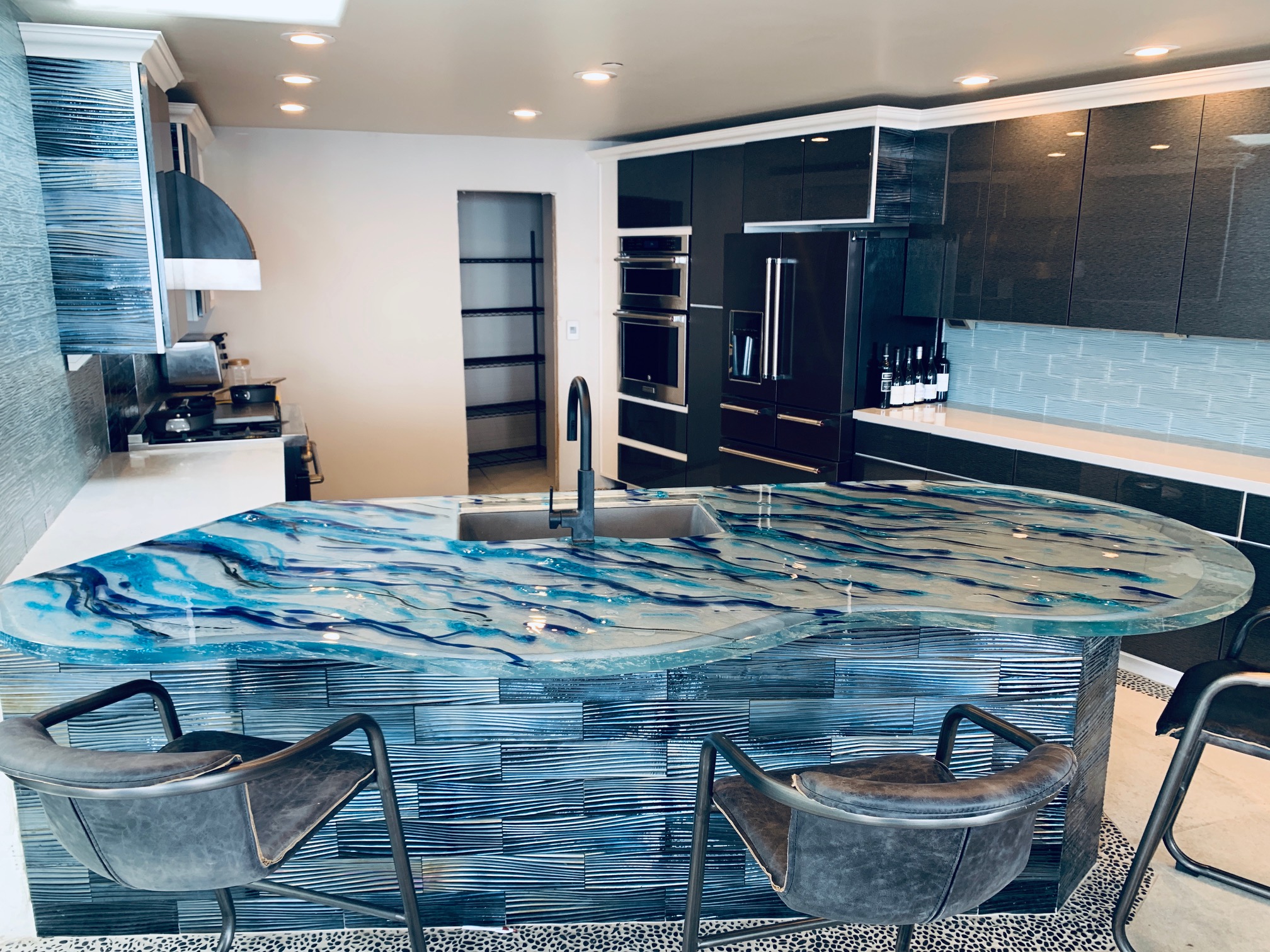
Glass can be completely personalized, unlike stone, which has inherent veining, or quartz, which follows industrial patterns. People who own homes can choose the colors, textures, patterns, and finishes. Frosted, etched, colored, or kiln-cast textures that look like real water, ice, or stone effects are some of the choices. You may also use glass with built-in LED lights to make a glowing centerpiece.
Long-lasting
Glass today is not weak. New methods of manufacturing, including as tempering, laminating, and fusing, have made slabs that can withstand scratches, heat, and everyday kitchen use. When properly specified, glass islands are as strong as stone countertops.
Non-Porous and Clean Glass does not soak up food, oils, or liquids. This means that it won't get stained or grow bacteria, making it a clean choice for kitchens that get a lot of use. On the other hand, porous stone like marble needs to be sealed, wood can soak up stains, and glass stays strong without any treatment.
A Green Choice
More and more people are able to get recycled glass composites and fused slabs that contain glass cullet from people who have already utilized it. Artisanal manufacturers, especially in North America, put sustainability first by using recyclable materials, making things with little waste, and delivering in ways that are good for the environment.
Material Types for Glass Kitchen Islands
1. Fused (Cast) Glass - The Artisanal Benchmark
- Process:
- Molten glass is poured into custom molds and cooled slowly (annealed) in a kiln.
- Produces thick slabs between 1.5” and 4” (38-100 mm) with rich texture and natural depth.
- Each piece is handcrafted, resulting in a one-of-a-kind architectural element.
- Molten glass is poured into custom molds and cooled slowly (annealed) in a kiln.
- Durability:
- Extremely resistant to scratches, chips, and heat.
- The solid mass of fused glass absorbs impact and minimizes vibration.
- Its natural texture conceals minor wear over time, maintaining its flawless aesthetic.
- Extremely resistant to scratches, chips, and heat.
- Design:
- Allows infinite customization—colors, textures, organic patterns, and integrated LED lighting.
- Adds artistic dimension and functional beauty to kitchen spaces.
- Allows infinite customization—colors, textures, organic patterns, and integrated LED lighting.
- Applications:
- Ideal for luxury residential kitchens, showroom islands, and architectural statement projects.
- ThinkGlass (Quebec) is a North American leader, known for its craftsmanship and sustainability practices.
- Ideal for luxury residential kitchens, showroom islands, and architectural statement projects.
2. Laminated Glass
- Process:
- Two or more sheets of glass are bonded together with a clear polymer interlayer such as PVB or EVA.
- The interlayer holds fragments in place if the glass fractures.
- Two or more sheets of glass are bonded together with a clear polymer interlayer such as PVB or EVA.
- Durability:
- Maintains structural integrity even when cracked.
- Provides superior impact resistance and safety in high-traffic environments.
- Maintains structural integrity even when cracked.
- Design:
- Can be tinted, frosted, or layered for acoustic or aesthetic benefits.
- Can be tinted, frosted, or layered for acoustic or aesthetic benefits.
- Applications:
- Perfect for family kitchens, hospitality settings, and commercial food spaces requiring reinforced safety.
- Perfect for family kitchens, hospitality settings, and commercial food spaces requiring reinforced safety.
3. Tempered Glass
- Process:
- Heated to approximately 1200°F (650°C) and rapidly cooled to induce surface compression.
- Creates a structure up to five times stronger than standard annealed glass.
- Heated to approximately 1200°F (650°C) and rapidly cooled to induce surface compression.
- Durability:
- Resistant to minor impacts, scratches, and thermal changes.
- When broken, it shatters into small, blunt pieces for safety.
- Resistant to minor impacts, scratches, and thermal changes.
- Design:
- Available in clear, tinted, or frosted finishes with optional edge polishing.
- Available in clear, tinted, or frosted finishes with optional edge polishing.
- Applications:
- Best suited for modern residential kitchens prioritizing simplicity and cost efficiency.
- Best suited for modern residential kitchens prioritizing simplicity and cost efficiency.
4. Recycled Glass Composites
- Process:
- Formed from post-consumer glass shards embedded in resin or cement binders.
- Each surface is unique, depending on the type and color of glass used.
- Formed from post-consumer glass shards embedded in resin or cement binders.
- Durability:
- Comparable to engineered quartz—scratch and stain resistant, but less luminous than solid glass.
- Comparable to engineered quartz—scratch and stain resistant, but less luminous than solid glass.
- Design:
- Distinct mosaic appearance with vibrant, eco-conscious character.
- Distinct mosaic appearance with vibrant, eco-conscious character.
- Applications:
Common in urban kitchens or sustainable building projects emphasizing environmental responsibility.
Durability and Performance
One of the most common wrong ideas regarding glass in kitchens is that it breaks easily. When designed correctly, architectural glass can actually be stronger and last longer than many typical countertop materials. Fused (cast) glass is different from the rest because its density, texture, and handmade thickness make it very resistant to daily wear and damage.
- Impact Resistance:
- Fused glass is exceptionally strong due to its solid mass, typically several inches thick. It resists chips and cracks even under heavy use.
- Tempered and laminated glass also perform well under normal kitchen conditions, withstanding everyday knocks from cookware and utensils.
- Fused glass is exceptionally strong due to its solid mass, typically several inches thick. It resists chips and cracks even under heavy use.
- Heat Resistance:
- Fused glass easily tolerates significant temperature variation without warping or discoloration.
- Tempered glass resists heat up to approximately 500°F (260°C), making it suitable for general kitchen use.
- Regardless of glass type, direct placement of extremely hot pans should be avoided to preserve long-term clarity and finish.
- Fused glass easily tolerates significant temperature variation without warping or discoloration.
- Scratch Resistance:
- The textured surfaces of fused glass naturally conceal small scratches and wear marks, maintaining beauty over decades.
- Modern tempered and laminated options resist abrasion from everyday use, though soft pads or mats are still recommended under metal cookware.
- The textured surfaces of fused glass naturally conceal small scratches and wear marks, maintaining beauty over decades.
- Moisture Resistance:
- Glass is completely non-porous, preventing absorption of water, oils, or stains.
- This makes it ideal for kitchens where hygiene, easy maintenance, and spill resistance are priorities—an advantage over porous materials such as wood or natural stone.
- Glass is completely non-porous, preventing absorption of water, oils, or stains.
Glass, when specified and crafted correctly, is not a delicate surface—it’s a long-lasting structural material that combines durability with timeless visual appeal. Fused glass, in particular, transforms that durability into design, offering both strength and artistry in a single, luminous form.
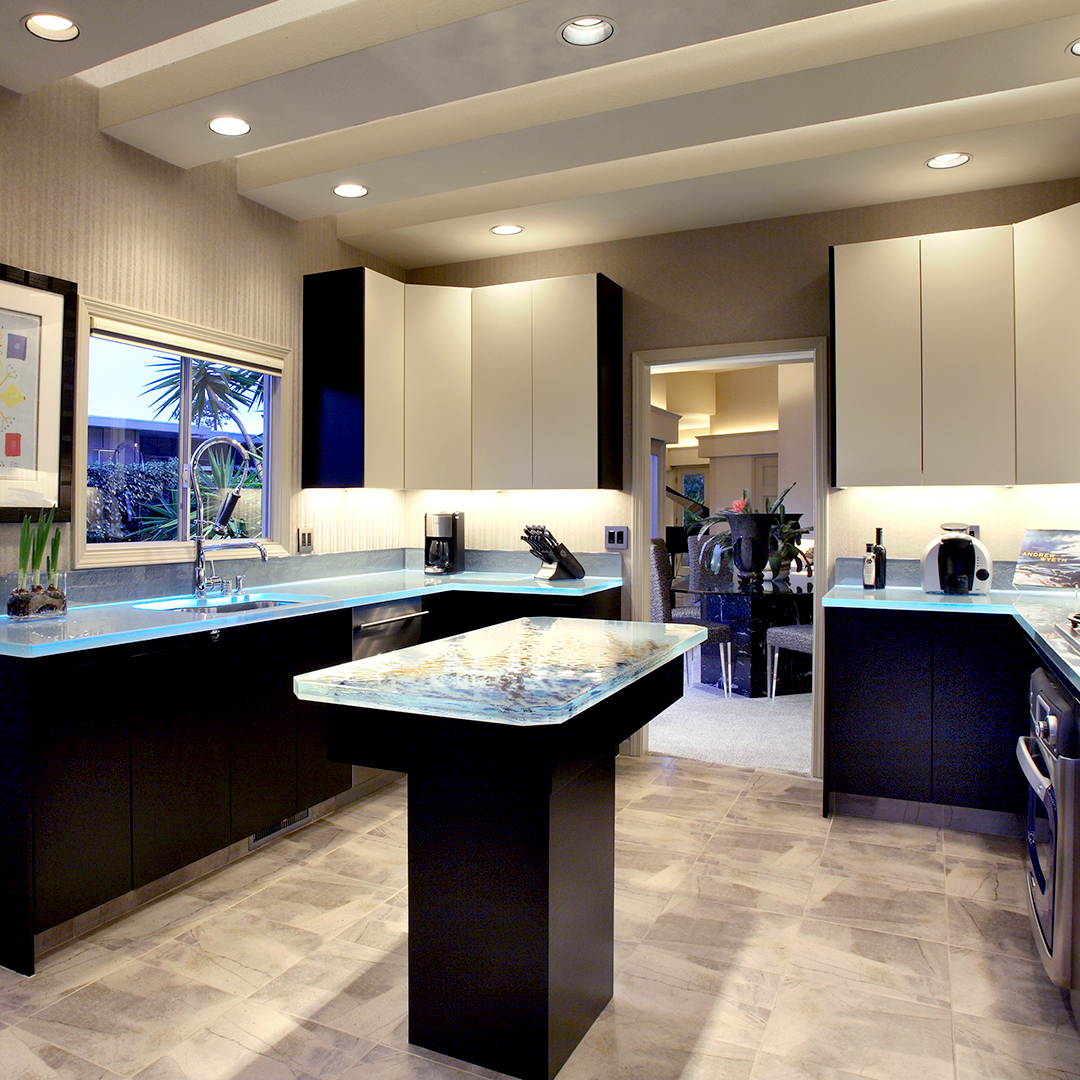
Design and Integration Ideas
When it comes to glass kitchen islands, design is just as important as function. People are starting to see them as statement items more and more in 2025.
Different Bases
Using glass with wood cabinets makes a pleasant, modern contrast. Metal frames make things look more industrial. Stone bases with glass tops show how solid and clear something can be at the same time.
Putting in LED
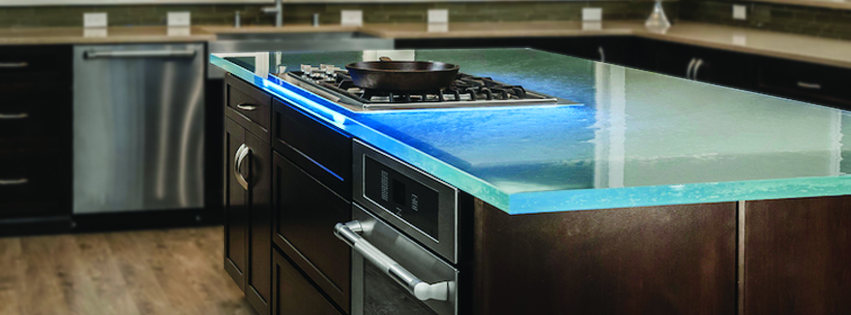
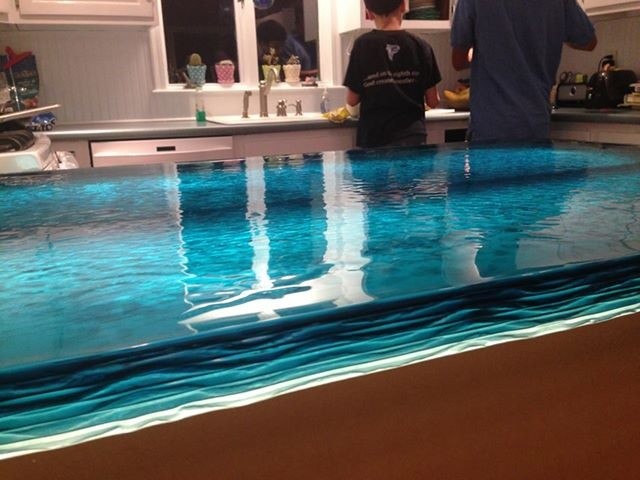
Embedded LED strips are possible with thick fused glass slabs. Backlighting brings out textures, sets the ambiance, and makes the island the center of attention for guests.
Finishes and Textures
Finishes can change the look and feel of a surface, as well as make it safer by making it less slippery. For example, frosted glass and kiln-cast textures that look like rippling water or frozen ice.
Mixed Materials
Glass overlays on wood or stone combine the usefulness of a non-porous surface with the visual weight of traditional materials.
Shapes and Layouts
Rectangular islands remain the most common, but curved glass is gaining popularity thanks to advanced fabrication.Waterfall edges, where glass flows down the sides, create seamless sculptural designs.Multi-level glass islands provide separate zones for preparation, dining, and serving.

Pros and Cons of Glass Kitchen Islands
Advantages
- Enhances natural and artificial light flow.
- Non-porous, hygienic, and stain resistant.
- Highly customizable with endless textures, colors, and lighting.
- Durable when engineered correctly.
- Supports sustainability with recycled content options.
Challenges
- Shows fingerprints and smudges more readily than matte surfaces.
- Premium fused/cast glass is costly compared to stone or quartz.
- Requires professional installation due to weight and fragility during handling.
- Can chip if struck at exposed edges.
Maintenance and Care
Compared to genuine stone or wood, keeping a glass kitchen island clean is easy.
- To get rid of fingerprints and stains, clean every day with a microfiber cloth and mild soap or glass cleaner.
- Don't use abrasives: Rough scrubbers or cleansers can scratch surfaces.
- Edge Care: Edges that are rounded or beveled are less likely to chip or hurt someone.
- Managing Heat: Trivets are ideal for hot pans because they are resistant to heat and won't cause thermal stress.
- Long-Term: You don't have to reseal or refinish glass like you do with stone or wood.
Market and Design Trends (North America 2025)
- Hybrid kitchens: Islands can be used as both dining and work areas as open design become more popular. Glass surfaces are flexible and still look good.
- Eco-Responsibility: Homeowners who care about the environment like recycled glass composites and glass that is made in a way that is good for the environment.
- High-end clients want unique handcrafted slabs with textures, hues, and LED integration.
- Integration of Technology: Glass islands with embedded lighting and even wireless charging are entering the luxury market.
- Regional Popularity: In urban areas, glass appeals for maximizing light in smaller condos. In suburban and luxury homes, cast glass islands serve as artistic centerpieces.
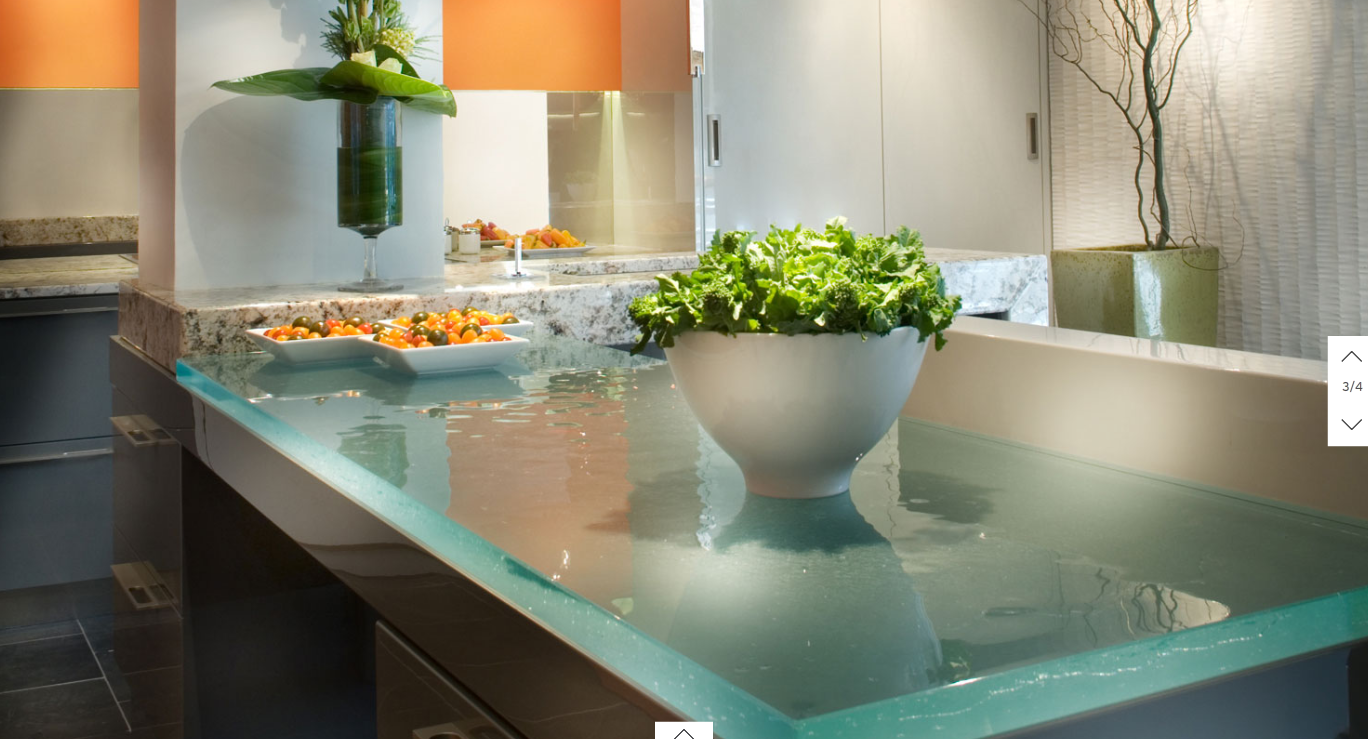
Comparative Overview: Types of Glass Kitchen Islands
In 2025 and 2026, glass kitchen islands will be the perfect mix of art, engineering, and usefulness. They make rooms brighter, give surfaces that are clean, and let you customize them in almost any way you like. There is a choice for every type of home, from a simple tempered glass surface to a family-friendly laminated slab to a spectacular cast glass centrepiece.
Glass islands are no longer a new thing for designers and homeowners in North America. They are now a popular choice that is just as durable as quartz and granite but more customizable and elegant.
If you choose the proper sort of glass, have it installed by an expert, and follow easy care tips, your kitchen island will not only work well, but it will also be the center of your house for many years.
Are glass kitchen islands durable enough for everyday cooking?Glass kitchen islands made with tempered, laminated, or cast glass are very durable and well-suited for daily use. They resist heat, impact, and scratches far better than standard glass, making them reliable for cooking and preparation tasks.
Do glass kitchen islands scratch easily?High-quality glass surfaces offer strong scratch resistance, especially cast or fused glass. Tempered and laminated glass also hold up well. Scratches can occur only if abrasive objects or metal tools are dragged across the surface, so using cutting boards helps protect the finish.
Is a glass kitchen island difficult to maintain or keep clean?Glass is non-porous and effortless to maintain. It does not absorb stains or bacteria and can be cleaned with simple soap and water or a mild glass cleaner. Fingerprints may appear on smooth finishes, but they wipe off quickly and easily.