


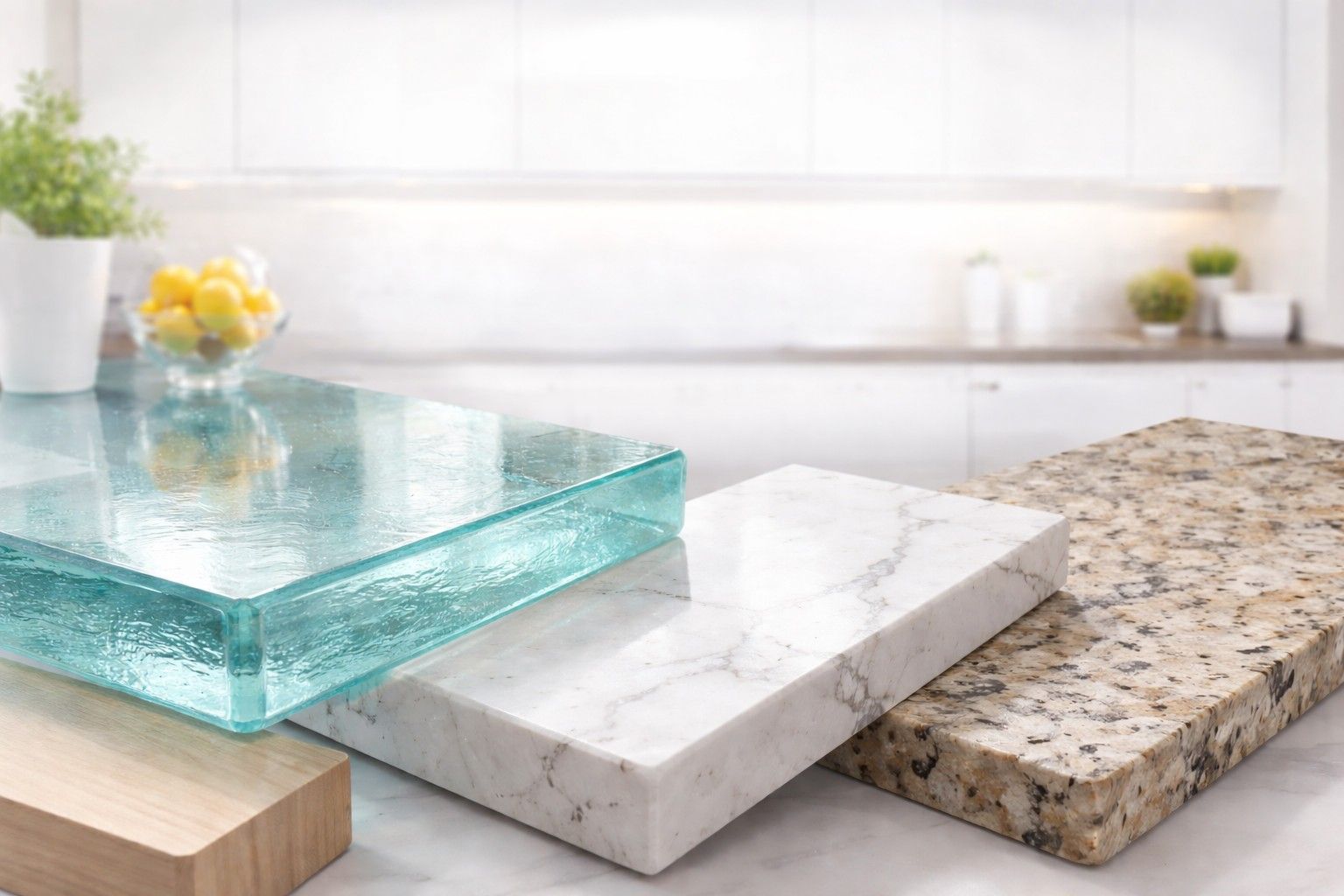
Choosing a countertop is often framed as a style decision, but the truth is more structural than most homeowners realize: you’re selecting a surface that will spend decades living through bending loads, edge impacts, thermal gradients, acids, dyes, cleaners, and the occasional “life happens” moment when someone drops a pot or forgets a trivet.
This article compares fused (thermoformed) glass, engineered quartz, and natural granite through three lenses that actually predict long-term satisfaction: mechanical behavior, hygiene and cleanability, and thermal performance. Because this is written for a ThinkGlass context, fused glass is treated as the benchmark material not as a novelty, and the comparison is structured to be useful for both specifiers and homeowners.
If you want to explore the applications while reading, the most natural starting points on ThinkGlass are the core countertops collection (material logic and design range), the dedicated kitchen countertop application (daily workflow realities), the bar countertop application (spills, wipe-down cycles, hospitality use), and the broader architectural applications hub (when the countertop is part of a larger glass language in the space).
What follows is not a “which is best” verdict. It’s a performance map: where each material wins, where it loses, and what design and installation decisions can swing the outcome dramatically.
Why this comparison is harder than it looks
Most online comparisons reduce everything to a few headline properties: Mohs hardness, stain resistance, and a vague idea of “heat resistance.” That’s not wrong, but it’s incomplete. Countertops fail and disappoint for reasons that are often invisible on day one:
A countertop rarely fails under pure compression; it fails under bending tension created by spans, overhangs, and uneven support
Hygiene is rarely about “day one porosity”; it’s about whether the surface remains easy to clean after years of micro-scratches, residue cycles, and real cleaning habits
Thermal damage is rarely about an absolute maximum temperature; it’s about thermal gradients, localized heat, and how constrained the slab is by the installation
So instead of treating glass, quartz, and granite as static “materials,” we’ll treat them as engineered systems. That’s how you get a decision you won’t regret.

Defining the three materials precisely
Fused (thermoformed) glass countertop
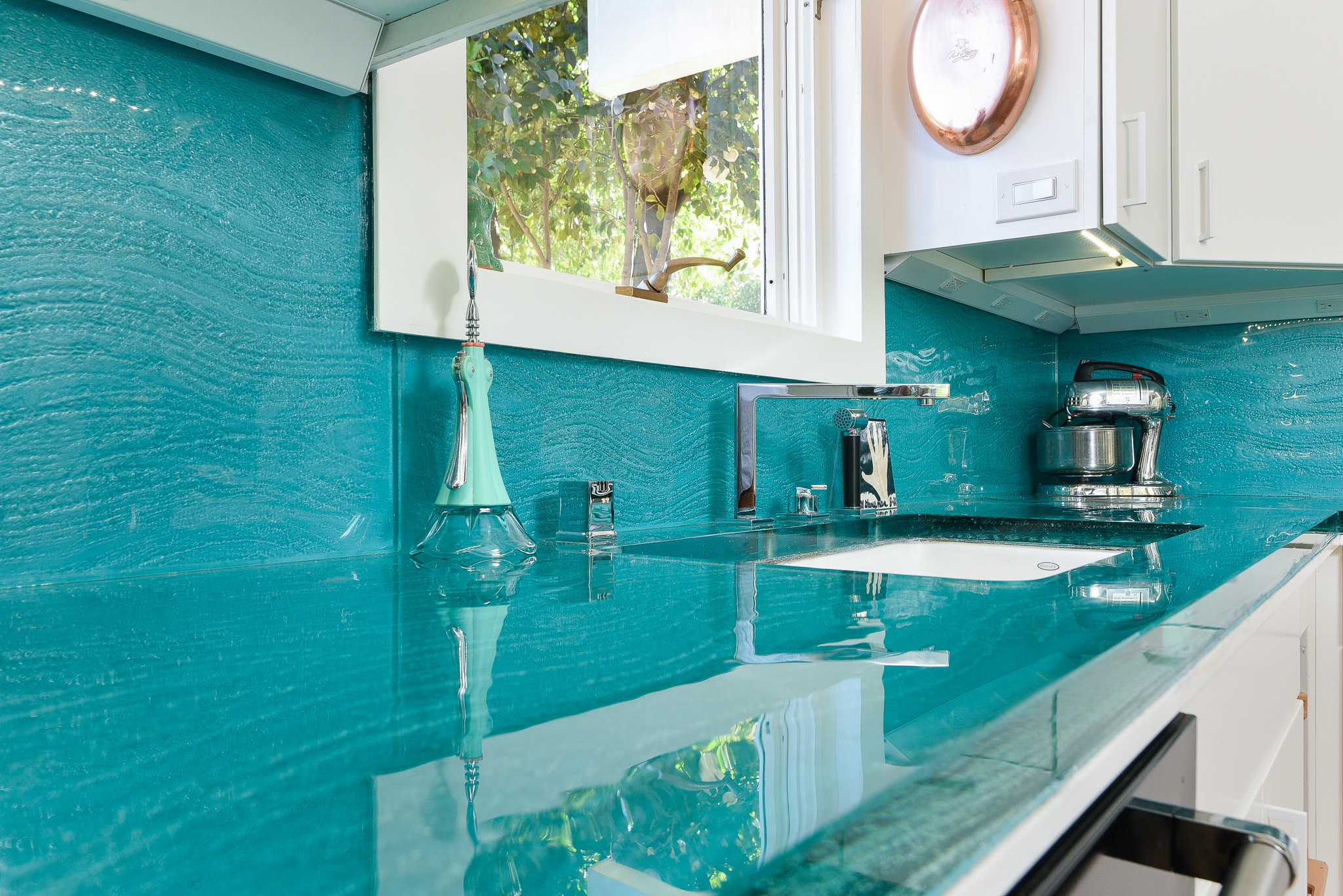
A fused glass countertop is not a thin pane. It is a thicker architectural glass element created through controlled heating and forming, producing depth, translucency, and texture as part of the structure. In practice, it behaves like a structural panel: strong in compression, sensitive to tensile stress concentrations, and highly dependent on support strategy and detailing.
In ThinkGlass projects, this is rarely a single isolated piece. It often belongs to a broader design ecosystem that can extend to glass stair treads and floors via stair treads and floors or into the vertical plane through architectural applications.
Engineered quartz countertop
Engineered quartz is a composite: crushed quartz aggregate bound together with polymer resins and pigments. It is designed for uniformity, predictable appearance, and daily resilience. Its performance is strongly influenced by resin content, manufacturing process, and surface finish.
The key advantage is that it behaves less “brittle” than natural stone under many everyday impacts, partly because the resin matrix can absorb energy that would otherwise propagate a crack.
Natural granite countertop
Granite is an igneous natural stone with interlocking mineral grains. Its appeal is natural variation, high heat tolerance in many everyday scenarios, and a sense of permanence. Its weakness is variability: micro-fissures, absorption differences, and the fact that many granite installations rely on sealing strategies to keep staining and absorption predictable over time.
Mechanical performance: what matters beyond hardness
Mechanical performance in countertops is not only “how hard is the surface.” It’s how the slab responds to bending, impact, and stress concentrations created by edges and cutouts.
Hardness and scratch behavior: why Mohs tells only part of the story
Mohs hardness is useful for predicting scratch hierarchy: harder materials scratch softer ones. It helps explain why quartz often feels “carefree” for daily abrasion and why glass can show scratches if you treat it like a cutting board.
But Mohs doesn’t predict chipping, fracture behavior, or what happens at a sink cutout corner. For that, you need to think in fracture mechanics: where cracks initiate, how they propagate, and how the installation either amplifies or suppresses tensile stress.
Glass, for example, is often perfectly stable for years and then fails catastrophically if a crack initiates at a sharp corner or an edge defect under a stress spike. Quartz may chip but not “run” as easily because the microstructure is different. Granite may hide a micro-fissure until a sharp blow triggers a visible crack.
Compression is the wrong hero metric, but it still teaches something
You mentioned compressive strength values and, conceptually, you’re on the right track: glass is extremely strong in compression relative to the loads countertops typically see. The problem is that countertops usually fail in tension created by bending, not in compression.
A simple way to visualize it:
When you press down on a countertop spanning cabinets, the top surface is compressed while the bottom surface is pulled into tension. Brittle materials “fear” tension because cracks open under tensile stress.
So the more relevant mechanical question becomes:
How well does the installation prevent excessive bending tension?
The real mechanical risk factors
Countertop disappointments often trace back to the same structural culprits:
Overhangs acting like cantilevers without adequate support
Long spans without continuous support
Cooktop and sink cutouts that leave thin “webs” of material
Sharp internal corners that act as crack initiators
Uneven cabinet tops that twist the slab and preload it with stress
Point-load shims or hard contact points that create local stress peaks
These issues can harm any material, but glass is less forgiving if the details are poor, because crack initiation and propagation can be sudden.
Where fused glass shines mechanically
When specified and supported properly, fused glass can feel surprisingly “massive” and stable under downward loads. It is also dimensionally stable and does not have the inherent micro-fissure variability of natural stone.
Its biggest mechanical strengths in real projects tend to be:
High stability under well-supported, continuous bearing conditions
Predictable behavior when cutouts and edges are designed with proper radii and finishing
Excellent performance in environments where hygiene and wipe-down cycles matter more than abrasion resistance
If you’re selecting for daily kitchen workflow, it makes sense to assess fused glass through the dedicated kitchen countertop application lens, because most mechanical stress events in kitchens are not dramatic: they’re subtle (leaning, stacking, heavy mixers, localized loads) and cumulative.
Where engineered quartz shines mechanically
Quartz is often the “daily resilience champion” for typical households because it has a high hardness and is relatively resistant to chips and scratches under normal use. The composite structure can be more forgiving of minor impacts than brittle stone.
Quartz typically wins for:
Busy households with frequent abrasion (kids, utensils, constant movement)
People who don’t want to think about cutting boards (even if they still should)
Projects where uniformity and repeatability matter (multiple slabs, consistent color)
Where granite shines mechanically
Granite performs well when you want a traditional stone surface that handles heavy use and generally tolerates day-to-day impacts. But because granite is natural, its performance is not uniform across slabs. Some stones are tougher than others, and micro-fissures can be invisible until stressed.
Granite tends to win for:Homeowners who love natural variation and accept maintenance ritualsKitchens that regularly see hot cookware and want a “no anxiety” thermal feelProjects where a traditional stone identity is part of the design goal
Hygienic performance: “non-porous” is not the whole story
Hygiene is where fused glass becomes unusually compelling, not because it is magically “sterile,” but because its cleanability is structurally simple.
Porosity and absorption in practice
A porous material doesn’t automatically become unhygienic, but it does become maintenance-dependent. If a surface’s stain resistance depends on a sealer film, then the hygiene performance is only as strong as the household’s consistency in maintaining that film.
Fused glass is fundamentally non-porous at the surface: there isn’t an open capillary network that absorbs liquids the way many stones can. This makes a difference for:
Acidic spills and dyes that sit longer than they should
Food prep areas where you want predictable wipe-down outcomes
Hospitality and bar environments where the surface sees constant contact and quick turnarounds
Quartz is also effectively non-porous in daily use because the resin-bound structure prevents the absorption patterns you see in many natural stones. For most households, that translates to high stain resistance without periodic resealing.
Granite can be low-absorption compared to many stones, but it is still a natural material with variability. Many granite owners rely on sealing schedules to keep absorption and staining predictable.
Hygiene is also about surface micro-topography over time
Even a non-porous surface can become harder to clean if it accumulates micro-scratches or residue films. This is where trade-offs appear:
Glass can show micro-scratches if subjected to repeated abrasion; these scratches don’t necessarily make it absorbent, but they can affect how residue films cling and how “perfect” the wipe-down looks under raking light
Quartz tends to hide minor abrasion better in many finishes, and it maintains a consistent wipe-down pattern for most households
Granite can remain beautiful but may develop “story marks” over time (etched areas, dulling, staining in high-use zones) if the seal is neglected or cleaners are harsh
Why bars and commercial spaces shift the hygiene equation
In bars and commercial spaces, hygiene is not only personal preference; it’s operational. Staff need surfaces that clean quickly, predictably, and without rituals.
That’s why the bar countertop application and commercial applications pages are relevant even if your project is residential. They teach you what happens when a surface is cleaned hundreds of times a week, not a few times a day.
If a surface stays visually and hygienically consistent under that pressure, it usually performs beautifully in a home.
Thermal performance: heat tolerance vs thermal shock vs resin limits
Heat is the category where myths thrive because people mix three different phenomena:
Heat tolerance (will the material degrade at a high temperature?)
Thermal shock resistance (will a rapid temperature gradient crack it?)
Heat damage aesthetics (will it discolor, haze, or dull even if it doesn’t crack?)
Granite: “hot pan confidence,” but not invincible
Granite is widely perceived as the most heat-tolerant option in everyday terms. Many owners place hot cookware directly on granite without immediate damage. That confidence is real, but the nuance is that extreme localized heat or prolonged heat can still cause issues, especially with sealants or resins used in installation environments.
Granite’s thermal identity is one of its strongest emotional selling points: it feels like a material that won’t punish you for a small mistake.
Quartz: the resin is the thermal weak link
Quartz aggregate itself tolerates high temperature well, but engineered quartz includes polymer resins. Those resins can discolor or degrade under high localized heat. This is why quartz manufacturers and technical manuals often recommend trivets and caution against direct hot cookware contact.
So quartz can be “heat resistant” in normal use, but not “heat proof” in the way many people assume when they hear “stone.”
Fused glass: strong material, but gradients matter
Glass as a material can handle high temperatures in many contexts, but countertops are not uniform-temperature objects. They experience localized gradients: a hot pot meets a cooler slab, the underside is insulated by cabinets, and cutouts create thin regions that heat and cool differently.
Fused glass thermal performance therefore depends heavily on:
Thickness and mass (more mass can buffer gradients)
Support and constraint (a stressed installation increases risk)
Cutout geometry (thin webs and sharp corners amplify thermal stress)
User behavior (direct-from-oven contact vs normal kitchen heat)
In well-engineered installations, fused glass handles everyday kitchen reality well. The risk scenario is rapid, extreme gradients and poor detailing, not ordinary cooking.

The one practical checklist that prevents most regrets
- If your lifestyle includes frequent “hot pan moments,” treat thermal behavior as a priority and assess how disciplined you are about trivets
- If your kitchen routine is hygiene-driven (raw prep, heavy wipe-down cycles, hospitality use), prioritize non-porous behavior and maintenance stability
- If your layout includes long spans or dramatic overhangs, prioritize support design and cutout detailing over material label
- If you want a coherent glass language across the project, explore the relationship between countertops and architectural applications or stair treads and floors early, before finalizing finishes
- If you choose quartz or granite, decide upfront whether you want a “low ritual” surface or you’re comfortable with periodic sealing and careful heat habits
Technical specs table: performance comparison you can actually use

What the “best” material looks like, depending on the buyer
If you care most about hygiene with minimal rituals
Fused glass and quartz tend to dominate because they don’t rely on periodic sealing to maintain stain resistance. Between them, fused glass often wins when you want hygiene plus architectural depth: it doesn’t just stay clean, it stays visually crisp in a way that’s hard to replicate with opaque composites.
This is especially true for environments with lots of wipe-down cycles and liquid exposure. It’s why bars and hospitality are such a useful benchmark. If you want to see that logic translated into real use-cases, the bar countertop application path is often more educational than generic countertop pages.
If you care most about “daily resilience” and not thinking too much
Quartz is often the best psychological fit for households that want a tough surface and minimal anxiety about scratches or minor knocks. It’s engineered for predictability, and many users love that they don’t have to interpret the personality of a natural slab.
If you care most about hot cookware tolerance and a traditional stone identity
Granite often delivers a feeling of robustness under heat and gives you a natural visual character many people still consider unmatched. The trade is that long-term stain and hygiene stability often depends on sealing behavior, and slab variability means you’re buying a specific stone, not a standardized material.
If you’re designing a “glass language” rather than a single countertop
Fused glass becomes more than a surface. It becomes a material strategy: countertop, island, vanity, wall panels, stair components, and floors can share a cohesive visual identity.
That’s when you stop thinking “glass versus stone” and start thinking “architectural continuity.” The practical entry point for that is architectural applications, with expansion into stair treads and floors if the project is ambitious.

Detailed FAQ
Does NSF/ANSI 51 mean glass, quartz, and granite are automatically “food safe” for my kitchen?
NSF/ANSI 51 is a sanitation standard for materials used in the construction of commercial food equipment. Its purpose is to establish minimum public health and sanitation requirements for materials in that specific context, and it includes strong language about cleanability and material performance expectations. You can verify the scope and intent directly in the ANSI preview PDF for the standard: NSF/ANSI 51 preview.
What it means practically: the standard is a useful reference for understanding why smooth, easily cleanable materials are favored in food environments, but it is not a blanket “certification stamp” applied to every residential countertop. The key takeaway for homeowners is the principle: surfaces that are inherently non-porous and easy to clean tend to maintain hygiene performance with fewer rituals.
See more : https://webstore.ansi.org/preview-pages/NSF/preview_NSF%2BANSI%2B51-2019.pdf
What do occupational safety authorities say about engineered quartz fabrication risks, and should homeowners worry?
Occupational safety guidance focuses on workers exposed to respirable crystalline silica during manufacturing, finishing, and installation of natural and manufactured stone countertops. The OSHA/NIOSH hazard alert explicitly states that workers involved in these processes can face significant silica exposure and describes mitigation controls.
For homeowners, this is primarily a supply-chain and fabrication ethics issue, not an end-use toxicity issue. A finished engineered quartz countertop in a home does not create the same silica dust scenario as cutting and grinding in a shop. The practical implication is to favor fabricators who use wet cutting, effective dust controls, and strong worker protection.
Reference: https://www.osha.gov/sites/default/files/publications/OSHA3768.pdf
Is it true that quartz “can only handle 300°F” and that the resin is the weak link?
Many technical resources and manufacturer-oriented documents frame quartz heat resistance as “moderate” and recommend trivets or hot pads for hot cookware. The essential logic is consistent: quartz aggregate is heat tolerant, but the polymer resin binder can discolor or degrade under high localized heat. A manufacturer technical data manual that explicitly recommends trivets/hot pads for intense heat exposure supports that conservative best practice.
In real kitchens, quartz often performs beautifully for everyday heat from appliances, but direct contact with very hot cookware is a known risk pattern. A good decision-making approach is behavioral: if you know your household routinely places hot pans down impulsively, prioritize heat confidence (often granite) or commit to trivets consistently.
Granite is said to tolerate very high temperatures. Does that mean trivets are unnecessary?
Granite is widely described as highly heat resistant in typical countertop contexts, and many homeowner-facing guides cite very high temperature thresholds for short exposures.
But “heat resistant” is not the same as “immune.” Prolonged heat, extreme localized gradients, and indirect effects (like damaging sealants or finishes) can still create problems. Trivets are still a best practice, but granite tends to punish forgetfulness less often than engineered quartz.
If fused glass can scratch more easily than quartz, why is it still treated as a premium benchmark?
Because the benchmark is not “highest Mohs hardness.” The benchmark is performance as a system: non-porosity, hygiene stability, optical depth, and architectural versatility. Fused glass is one of the rare surfaces that can behave like an engineered material while also acting like a design element, especially when backlighting, texture, and thickness are part of the specification.
If your project values durability plus a signature look, browsing the countertops collection alongside architectural applications is often the shortest path to deciding whether you’re selecting a surface or selecting a material language.
What is the single biggest installation factor that can make glass, quartz, or granite underperform?
Support quality and stress management. Long spans, overhangs, uneven cabinet tops, and poorly engineered cutouts create bending tension and stress concentrations. Those stresses can cause cracks in granite, chips or discoloration issues in quartz, and fracture risk in glass. In other words, the “material choice” is often less decisive than the engineering and installation discipline.
If I want the most hygienic option with the least maintenance, should I always choose fused glass?
Not automatically. If your household is highly abrasive (sand, frequent dragging of cookware, heavy scouring), you may be happier with quartz’s abrasion tolerance even though fused glass remains non-porous and hygienically stable.
But if hygiene, wipe-down predictability, and design depth are top priorities, fused glass is extremely compelling especially in kitchens, bars, and vanities where the surface is constantly exposed to liquids and cleaning cycles.