

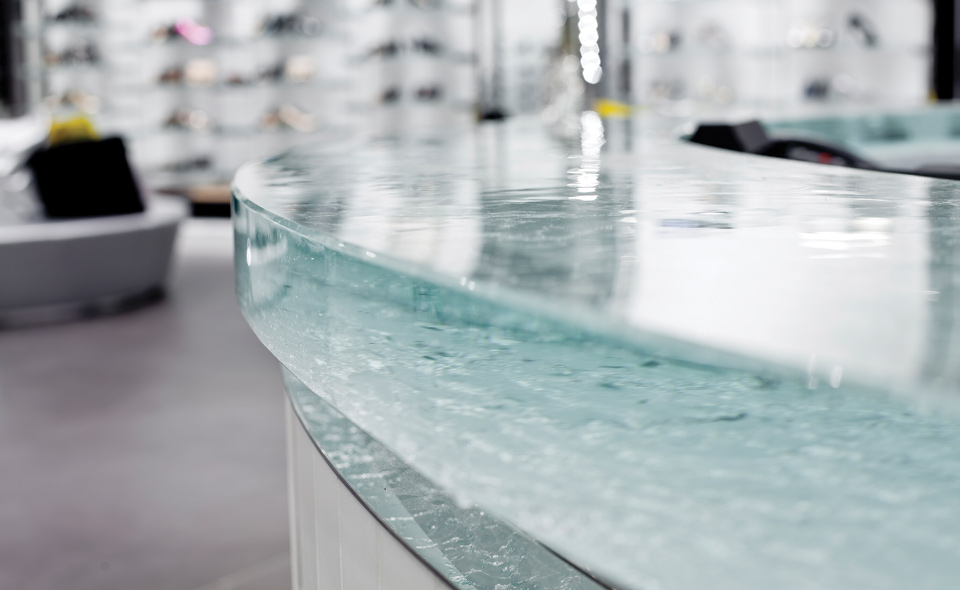
Fused (thermoformed) architectural glass is often introduced as a design statement: luminous, deep, textured, sometimes backlit, always unusual. But the reason it has earned a real place beside quartz and granite is not only aesthetic. Done correctly, fused glass behaves like a high-performance engineered material: stable, non-porous, hygienic, and structurally credible when it’s specified and supported as a system rather than treated like a decorative sheet.
If you want to stay inside ThinkGlass while reading, these are the most natural entry points that match how people actually choose a surface: the main countertops collection page for the overall material logic, the kitchen countertops path for workflow and daily-use realities, the bar countertop lens for hospitality-grade wipe-down and spill patterns, and the architectural applications hub when the project is bigger than a single room.
What follows is a deliberately “mechanistic” read: not marketing, not mythology, and not a simplistic Mohs-hardness comparison. It’s a grounded explanation of what fused glass is, how it behaves under real loads (impact, heat gradients, cutouts), why hygiene is not a buzzword, and where quartz and granite still have a practical advantage.

What “fused glass” actually is, and why the definition changes everything
When people say “glass countertop,” they can mean several very different families of products:
- Glass bonded to a substrate (more like a laminate panel)
- Laminated glass assemblies (multiple plies with an interlayer)
- Tempered monolithic glass (flat heat-treated glazing)
- Fused (thermoformed) glass (heat-softened, shaped, fused into a thicker mass)
Fused (thermoformed) glass is distinct because it is shaped and fused at elevated temperature into a thicker, monolithic piece (or into a controlled assembly where thickness and geometry are part of the design). This matters because the physics of a countertop are dominated by bending stiffness, local stress concentrations, and support conditions. Thickness, geometry, and how stresses are “locked in” during thermal processing govern how the surface responds to impact, load, and thermal gradients.
A helpful mental model is to treat a fused glass countertop less like “a fragile window” and more like “a structural panel with a finish.” That is also how high-performing installations are designed in practice: the countertop is an engineered element supported by cabinetry or a subframe, with details (cutouts, edges, seams, fasteners) designed to avoid stress concentrators.
This system view is why fused glass can be profoundly reliable in kitchens, bars, and commercial environments. And it’s also why glass has a reputation split in two: spectacular when engineered well, disappointing when treated like décor.
Glass is not weak, but unforgiving of bad detailing
Most breakage myths come from thin glass failing in bending or from badly supported installations. Countertops are not designed like windows; they’re designed like load-bearing components. That changes the stress profile dramatically.
The core engineering facts that matter:
- Glass is strong in compression and weaker in tension.
- Countertop stresses are often tensile stresses created by bending.
- Bending stresses spike at edges, corners, holes, and cutouts.
- Support strategy can reduce bending by orders of magnitude.
So the honest question is not “Is glass strong?” It’s “Will the design avoid creating avoidable tensile peaks?”
What creates tensile peaks in real countertops?
- Spans that are too large without continuous support
- Overhangs that behave like cantilevers without proper reinforcement
- Sink cutouts with sharp internal corners
- Cooktop cutouts with tight radii and thin webs
- Cabinetry that is twisted or out-of-level, forcing the top into torsion
- Point loads from hard shims or uneven contact
When these conditions exist, even “strong” materials can fail. Granite can crack. Quartz can chip or suffer resin-related heat discoloration. Glass can fracture, but thickness is the key making it resistant. The material is not the whole story; the details are.
Why safety glazing standards still matter (even if a countertop is not a window)
When people hear “safety glass,” they often think the same rules as windows and doors automatically apply. In North America, those rules are mostly written for glass people might accidentally hit, and the goal is to reduce the risk of cutting injuries if it breaks. (ANSI Z97.1: Safety Glazing Materials Used in Buildings) Canada has a similar safety glazing framework in CAN/CGSB-12.1. (CAN/CGSB-12.1 Safety glazing (PDF))
A countertop is different from a window. It is not automatically a “safety glazing application,” so you should not assume a countertop is certified to glazing impact standards just because the surface is glass.
For thick annealed glass that is fully supported like a countertop, the most directly relevant material reference is the standard for flat, annealed glass quality, ASTM C1036. (ASTM C1036 Standard Specification for Flat Glass) You may also see ASTM C1048 mentioned in the glass world, but it only applies to heat treated glass (heat strengthened or fully tempered), so it does not apply to an annealed countertop. (ASTM C1048 Standard Specification for Heat-Strengthened and Fully Tempered Flat Glass)
What makes a thick annealed glass countertop safe in normal use is straightforward and familiar, similar to stone surfaces. The slab is thick, it is supported continuously so it is not spanning like a window, and the edge is finished and chamfered so everyday bumps are less likely to chip a sharp corner. (ASTM C1036 Standard Specification for Flat Glass)
Hygiene is not branding: why non-porous behavior changes daily life
If you step back from kitchen aesthetics and ask a more clinical question-“What makes a surface easy to keep sanitary over years?”-you keep returning to the same properties:
- Smooth, easily cleanable surfaces
- Low porosity (not just low staining, but low absorption)
- Predictable maintenance without periodic performance “resets”
In commercial sanitation logic, NSF/ANSI 51 includes explicit language that materials should be smooth and easily cleanable (and it addresses glass and glass-like materials within the wider ecosystem of food equipment materials and finishes).
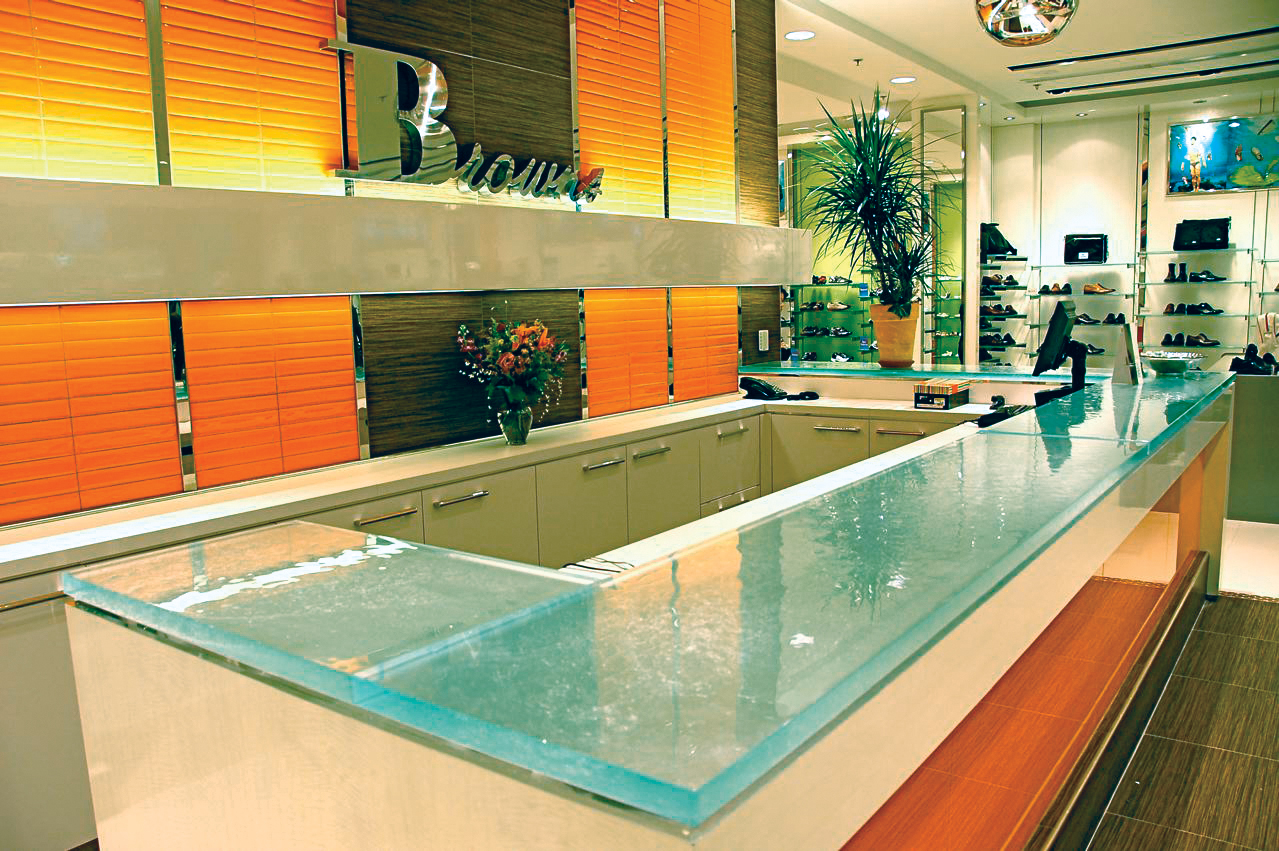
It’s important to be precise here: NSF/ANSI 51 is about commercial food equipment materials, not your residential island. But it provides an excellent engineering vocabulary to explain why fused glass behaves so well in kitchens and bars: if a surface is inherently non-porous and does not depend on sealants to block absorption, the “cleanability” you experience is more stable over time.
- That stability matters in the messiest real-world scenarios:
- Red wine that sits longer than you intended
- Citrus and vinegar splashes that get missed during a rushed clean
- Coffee oils, spice pigments, and sticky syrups
- Constant wipe-down cycles in bars and commercial spaces
Granite can be fantastic, but it is variable by nature and often depends on sealing regimes to keep absorption and staining predictable. Quartz is typically low-porosity but includes a resin matrix, and its long-term behavior depends on chemistry, heat exposure, and manufacturer formulation. Fused glass tends to be simpler in this respect: the surface itself is not an absorbent network.
This is why readers who start on glass countertops often end up navigating by use-case: the hygiene and cleaning logic becomes more obvious when you view the dedicated bar countertop pathway (spills, acids, wipe-down chemistry, constant contact) rather than thinking only in “kitchen trends.”
Heat and “thermal shock”: the part everyone oversimplifies
Most countertop debates collapse into a single question: “Can I put a hot pan on it?” That question is understandable, but the physics are more nuanced than a single “maximum temperature.”
- Thermal shock risk is primarily driven by temperature gradients and constraint:
- A very hot object contacts a much cooler surface
- The contact area is small (steeper gradient)
- The underside is insulated (heat can’t dissipate evenly)
- The slab is constrained or stressed by installation (added baseline stress)
Here’s the uncomfortable truth: every premium surface has a thermal limit scenario. Granite is often tolerant of everyday heat, yet rapid localized gradients can still create stress-especially if the stone contains micro-fissures or moisture. Quartz is frequently more heat-sensitive because resins can discolor or degrade under extreme localized heat. Glass can handle high temperatures as a material, but thermal gradients can create tensile stress.
So the pragmatic best practice is universal: trivets for extreme heat events. The difference is what happens when you occasionally forget. In well-engineered fused glass installations-thick slab, correct support, disciplined cutout radii-everyday cooking reality is usually not a problem. The “risk zone” tends to be extreme localized gradients or poor installation, not normal use.
If the project is outdoors (sun/shade gradients, freeze-thaw environments, UV exposure to any lighting components), it’s wise to treat this as a true assembly decision and start from the dedicated outdoor countertop context, because the environment becomes a stronger variable than the material label.
The design advantage that is actually a performance advantage: depth, light, and geometry
Designers pick fused glass for depth, translucency, and texture. But those choices can also improve the lived experience:
Depth and translucency make backlighting possible, improving nighttime navigation in kitchens and hospitality spaces
Textures can reduce the visibility of fingerprints and micro-smudges while preserving cleanability when engineered properly
Edge geometry can be designed to feel thicker and more solid, improving perceived durability
A coherent glass language can be extended beyond countertops into stair treads, floors, and wall panels
That last point is often overlooked. A design practice that thinks in “systems” can create continuity across horizontal and vertical applications-especially if the reader moves from countertops toward stair treads and floors and then toward architectural wall and panel logic through architectural applications.
This is where fused glass stops being “a countertop choice” and becomes a material strategy.

Chemically inert, low maintenance by nature
Fused glass is an inorganic, fully fused surface, so its day to day behavior does not depend on a resin binder or a penetrating sealer to “block absorption.”
Glass is widely used where chemical durability matters because it is resistant to water, many acids, salts, and common solvents, with a few well known exceptions like hydrofluoric acid and strong hot alkalis, not products that you find outside a laboratory.
For a countertop owner, the practical benefit is stability: performance is built into the surface itself, so cleanability and stain resistance are less tied to re sealing schedules or chemistry drift over time.
Light and UV stability, especially for bright kitchens and backlighting
UV light is harsh on many organic materials because it can trigger chemical aging, including yellowing and loss of clarity in polymer systems over time. That is why UV aging is a real engineering topic in resins, and it is measurable in published studies.
Fused glass is an inorganic network, so the visual effect is carried by the glass itself and its texture, not by an organic matrix, which is one reason glass tends to keep a stable appearance in bright spaces and in designs that rely on translucency or backlighting.
Shape stability over time, low creep in normal countertop conditions
Some materials can slowly deform under constant load, a phenomenon called creep, and polymers are well known to show time dependent deformation because they are viscoelastic.
With thick, fully supported fused glass, the slab’s long term shape is dominated by elastic behavior and the support geometry, rather than a binder that can gradually relax under load.
For clients, this is a simple message: once a glass countertop is engineered and installed correctly, it tends to stay geometrically consistent without relying on a “composite matrix” to hold its shape.
Where fused glass tends to win in real-world projects
Materials that require periodic sealing or meticulous ritual maintenance often perform well only for the most disciplined households. A surface that stays stain-resistant and visually consistent with normal cleaning is a very different value proposition.
Hygiene and wipe-down reality
If the countertop is in a high-contact environment (bar, café, hospitality), the difference between “cleanable” and “operationally cleanable” becomes stark. This is why the commercial applications framing is not optional for specifiers who are designing for staff workflows rather than homeowner habits.

Visual longevity
Even when granite and quartz remain structurally sound, they can visually age through micro-staining, etching, or resin-related discoloration depending on usage and environment. Fused glass often keeps a more stable visual identity because it is non-porous and does not depend on topical sealants to prevent absorption.
Architectural expression that doesn’t force a compromise
With fused glass, the “design choice” is not separate from performance. Translucency, thickness, textures, and edges can be part of the functional brief, not only the aesthetic brief.
The trade-offs you should acknowledge (because credibility depends on it)
- Scratch behavior
Glass can show scratching if you treat it like a cutting board and regularly drag abrasive grit across it. If your household is high-abrasion (sand, heavy scouring, careless utensil use), quartz may feel more forgiving.
- Edge impacts
Edges are stress-sensitive in almost every brittle material, including stone. Glass can chip if struck hard enough in the wrong way. Edge profiling and quality finishing reduce risk, but they do not remove physics.
- Support and installation sensitivity
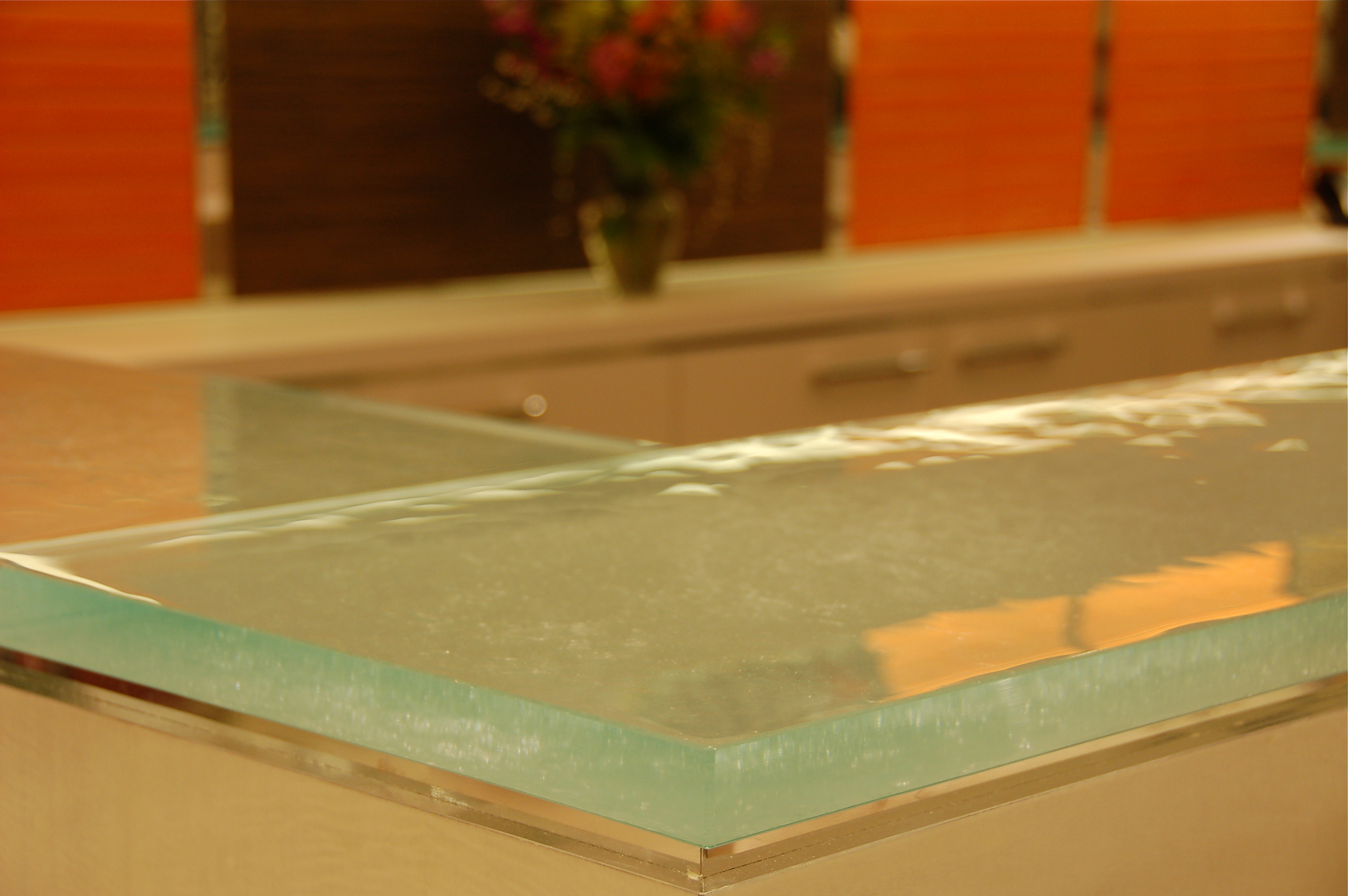
Fused glass countertops still require proper support and careful installation, just like any premium surface. A 1 1/2 inch thick glass slab is not fragile in normal use, and when it is continuously supported on flat, level cabinetry with proper contact and spans within engineering limits, breakage is highly unlikely.
A fair interpretation is not “glass is fragile.” It’s “glass requires system thinking.” For many projects-especially those that value hygiene, light, and sculptural geometry-that trade is rational.
One short checklist
When you’re validating a fused glass countertop proposal (or comparing it to quartz/granite), this checklist catches most of the hidden risk:
- Confirm the support strategy (continuous support, span limits, overhang rules)
- Validate cutout engineering (corner radii, reinforcement strategy, minimum webs)
- Ask about edge finishing and profiles (edges are crack-initiation sensitive)
- Clarify seam strategy (visual continuity and mechanical logic)
- Match cleaning guidance to the environment (residential vs bar vs commercial)
- If outdoors, treat it as an assembly decision (UV, freeze-thaw, lighting components)